
A new visual approach to pendulum period determination
DOI:
https://doi.org/10.31349/RevMexFisE.23.020216Keywords:
Simple pendulum, Pendulum period, Geometric methods, Introductory mechanics, History of physicsAbstract
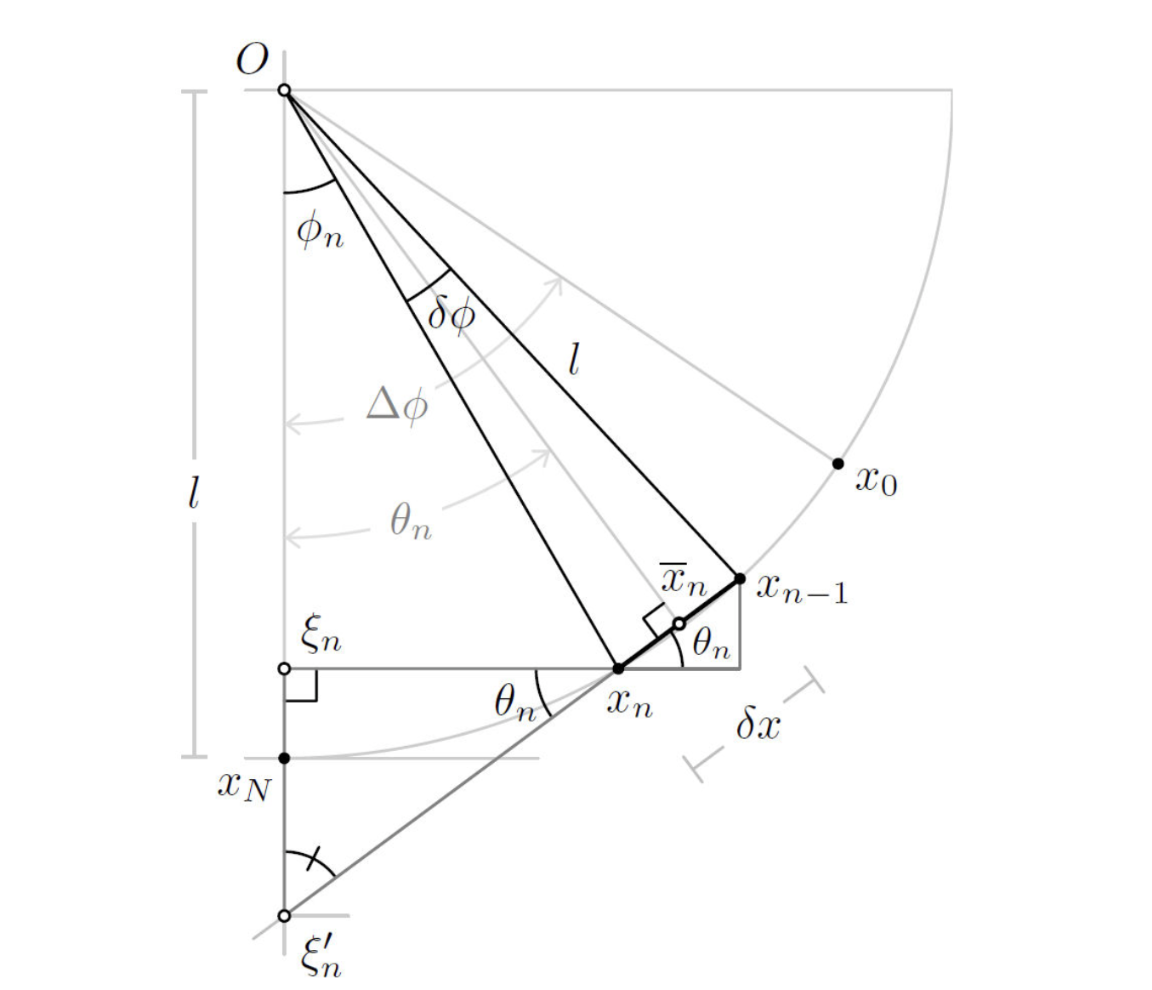
The period of oscillation of a simple pendulum ($T = 2\pi\sqrt{l/g}$) is a familiar formula to most first-year physics students. However, deriving this expression from first principles requires linearizing the equation of motion under the small-angle approximation and solving the resulting differential equation. From our point of view, this method may seem obscure to students in the early stages of learning calculus and lacking in physical insight. Therefore, we propose an alternative approach to the derivation of this formula that relies on geometry, algebra, and physical intuition. Our method follows the foundational idea of integral calculus, replacing the circular path of the pendulum with a successive collection of infinitesimal inclined planes and summing the travel times along each plane as the number of planes becomes very large. Remarkably, evaluating the limit of this sum relies solely on geometric reasoning, making the approach accessible to any student, even those not yet familiar with differential equations or integration techniques.
Downloads
References
J. G. Yoder, Unrolling Time: Christiaan Huygens and the Mathematization of Nature (Cambridge University Press, 1989), https://doi.org/10.1017/CBO9780511622441
C. Gauld, The Treatment of Cycloidal Pendulum Motion in Newton’s Principia, Science & Education 13 (2004) 663-673, https://doi.org/10.1007/s11191-004-3285-1
K. Simonyi, C. Simonyi, and D. Kramer, A Cultural History of Physics (A K Peters/CRC Press, 2025), https://doi.org/10.1201/9781032697697
M. R. Matthews, C. Gauld, and A. Stinner, The Pendulum: Its Place in Science, Culture and Pedagogy, Science & Education 13 (2004) 261-277, https://doi.org/10.1023/b:sced.0000041867.60452.18
J. R. Taylor, Classical mechanics (University science books, 2005)
H. Goldstein, C. P. Poole, and J. L. Safko, Classical mechanics (Pearson, 2011)
D. G. Zill, A First Course in Differential Equations with Modeling Applications, 9th ed. (Cengage Learning, 2009)
C. Huygens, Horologium Oscillatorium Sive de Motu Pendulorum ad Horologia Aptato Demonstrationes Geometricae (F. Muguet, 1673)
Émilie du Chatelet, Institutions de Physique (Prault fils, 1740)
Downloads
Published
How to Cite
Issue
Section
License
Copyright (c) 2026 R. Sánchez-Martínez, E. Heredia-Muñoz

This work is licensed under a Creative Commons Attribution-NonCommercial-NoDerivatives 4.0 International License.
Authors retain copyright and grant the Revista Mexicana de Física E right of first publication with the work simultaneously licensed under a CC BY-NC-ND 4.0 that allows others to share the work with an acknowledgement of the work's authorship and initial publication in this journal.