
SLAFEX 2024: Current vs voltage characteristic in an Al0.1In0.9As/InAs0.09N0.01/Al0.1In0.9As double-barrier heterostructure
DOI:
https://doi.org/10.31349/RevMexFis.72.030504Keywords:
Current; voltages; tunneling; impurity; double barrierAbstract
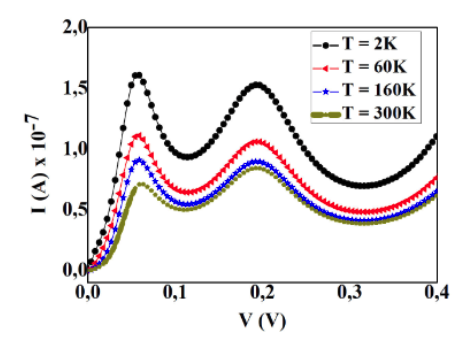
This article reports the study of the characteristic behavior of current in function of applied voltage for a double-barrier heterostructure (DBH) of InAsAl/InAsN/InAsAl, considering low Nitrogen concentrations (< 1%) for different temperature values and with a magnetic field applied parallel and/or perpendicular to the double barrier system. This work used the theory of non-equilibrium Green’s function (NEGF). The current-voltage curves show new resonant states due to the incorporation of Nitrogen in the quantum well and the intensity of these peaks diminishes with the increased temperature. In addition, our results show that the effect of the applied magnetic field perpendicular to the current is stronger compared with the applied magnetic field parallel to the current, yielding a behavior similar to the experimental data by Di Paola [Sci. Rep. 2016; 6, 32039].
Downloads
References
D.K. Shih, H.H. Lin, L.W. Sung, T.Y. Chu, and T.R. Yang, Band gap reduction in InAsN alloys, Jpn. J. Appl. Phys. 42 (2003) 375, https://doi.org/10.1143/JJAP.42.375 DOI: https://doi.org/10.1143/JJAP.42.375
A. Patanè et al., Effect of low nitrogen concentrations on the electronic properties of InAs1−xNx, Phys. Rev. B 80 (2009) 115207, https://doi.org/10.1103/PhysRevB.80.115207 DOI: https://doi.org/10.1103/PhysRevB.80.115207
O. Drachenko et al., Cyclotron resonance mass and Fermi energy pinning in the In(AsN) alloy, Appl. Phys. Lett. 98 (2011) 162109, https://doi.org/10.1063/1.3583378 DOI: https://doi.org/10.1063/1.3583378
D.R. Hang et al., Large effective mass enhancement of the InAs1−xNx alloys in the dilute limit probed by Shubnikov-de Haas oscillations, Physica E 22 (2004) 308, https://doi.org/10.1016/j.physe.2003.12.008 DOI: https://doi.org/10.1016/j.physe.2003.12.008
R. Kudrawiec, J. Misiewicz, Q. Zhuang, A. M. R. Godenir, and A. Krier, Photoreflectance study of the energy gap and spin-orbit splitting in InNAs alloys, Appl. Phys. Lett. 94 (2009) 151902, https://doi.org/10.1063/1.3117239 DOI: https://doi.org/10.1063/1.3117239
M. de la Mare, Q. Zhuang, A. Krier, A. Patanè, and S. Dhar, Growth and characterization of InAsN/GaAs dilute nitride semiconductor alloys for the midinfrared spectral range, Appl. Phys. Lett. 95 (2009) 031110, https://doi.org/10.1063/1.3187534 DOI: https://doi.org/10.1063/1.3187534
J. Ibáñez et al., Structural and optical properties of dilute InAsN grown by molecular beam epitaxy, J. Appl. Phys. 108 (2010) 103504, https://doi.org/10.1063/1.3509149 DOI: https://doi.org/10.1063/1.3509149
M. Kuroda, A. Nishikawa, R. Katayama, and K. Onabe, Growth and characterization of InAsN alloy films and quantum wells, J. Crystal Growth 278 (2005) 254, https://doi.org/10.1016/j.jcrysgro.2005.01.075 DOI: https://doi.org/10.1016/j.jcrysgro.2005.01.075
H. Benaissa, A. Zaoui, and M. Ferhat, First principles calculations for dilute InAs1−xNx alloys, J. Appl. Phys. 102 (2007) 113712, https://doi.org/10.1063/1.2821144 DOI: https://doi.org/10.1063/1.2821144
A. Gueddim and N. Bouarissa, Electronic structure and optical properties of dilute InAs1−xNx: pseudopotential calculations, Phys. Scr. 80 (2009) 015701, https://doi.org/10.1088/0031-8949/80/01/015701 DOI: https://doi.org/10.1088/0031-8949/80/01/015701
D. M. Di Paola et al., Resonant Zener tunnelling via zerodimensional states in a narrow gap diode, Sci. Rep. 6 (2016) 32039, https://doi.org/10.1038/srep32039 DOI: https://doi.org/10.1038/srep32039
H. Kleemann et al., Organic Zener diodes: tunneling across the gap in organic semiconductor materials, Nano Lett. 10 (2010) 4929, https://doi.org/10.1021/nl102916n DOI: https://doi.org/10.1021/nl102916n
A. Tibaldi, M. Goano, and F. Bertazzi, Small-signal modeling of dissipative carrier transport in nanodevices with nonequilibrium Green’s functions, Phys. Rev. Applied 19 (2023) 064020, https://doi.org/10.1103/PhysRevApplied.19.064020 DOI: https://doi.org/10.1103/PhysRevApplied.19.064020
M. Żak et al., Tunnel junctions with a doped (In,Ga)N quantum well for vertical integration of III-nitride optoelectronic devices,Phys. Rev. Applied 15 (2021) 024046, https://doi.org/10.1103/PhysRevApplied.15.024046 DOI: https://doi.org/10.1103/PhysRevApplied.15.024046
M. Nagase, Theoretical analysis of current-voltage characteristics of GaN/AlN resonant tunneling diodes including electron phase relaxation in quantum well, Jpn. J. Appl. Phys. 64 (2025) 061002, https://doi.org/10.35848/1347-4065/addd79 DOI: https://doi.org/10.35848/1347-4065/addd79
R. Golizadeh-Mojarad and S. Datta, Nonequilibrium Green’s function based models for dephasing in quantum transport, Phys. Rev. B 75 (2007) 081301, https://doi.org/10.1103/PhysRevB.75.081301 DOI: https://doi.org/10.1103/PhysRevB.75.081301
S. Datta, in Quantum Transport: Atom to Transistor, edited by Cambridge University Press (2005) p. 145. 18. H. Paredes Gutiérrez, N. Porras-Montenegro and A. Latgé, Magnetic field and hopping effects on the current-voltage characteristics in a GaAs/AlxGa1-xAs double-barrier heterostructure, Phys. Rev. B 68 (2003) 045311, https://doi.org/10.1103/PhysRevB.68.045311 DOI: https://doi.org/10.1103/PhysRevB.68.045311
M. A. Davidovich, Effects of carrier mass differences on the IV characteristics of resonant interband tunneling structures in the presence of parallel magnetic field, J. Appl. Phys. 78 (1995) 5467, https://doi.org/10.1063/1.359662 DOI: https://doi.org/10.1063/1.359662
I. Vurgaftman, J. R. Meyer and L. R. Ram-Mohan, Band parameters for III-V compound semiconductors and their alloys, J. Appl. Phys. 89 (2001) 5815, https://doi.org/10.1063/1.1368156 DOI: https://doi.org/10.1063/1.1368156
M. Ameri et al., Ab initio calculations study of structural and electronic properties of ternary alloy AlxIn1−xAs, Materials Sciences and Applications, 3 (2012) 674, https://doi.org/10.4236/msa.2012.310099 DOI: https://doi.org/10.4236/msa.2012.310099
E. P. O’Reilly, A Lindsay, P. J. Klar, A. Polimeni and M. Capizzi, Trends in the electronic structure of dilute nitride alloys, Semicond. Sci. Technol. 24 (2009) 033001, https://doi.org/10.1088/0268-1242/24/3/033001 DOI: https://doi.org/10.1088/0268-1242/24/3/033001
P. Virtanen et al., SciPy 1.0: Fundamental Algorithms for Scientific Computing in Python, Nature Methods 17, 261-272 (2020) https://doi.org/10.1038/s41592-019-0686-2 DOI: https://doi.org/10.1038/s41592-019-0686-2
G. Van Rossum and F. L. Drake Jr, Python reference manual (Centrum voor Wiskunde en Informatica Amsterdam, 1995). https://dl.acm.org/doi/book/10.5555/1593511
G. T. Einevoll and L. J. Sham, Boundary conditions for envelope functions at interfaces between dissimilar materials, Phys. Rev. B, 49 (1994) 10533, https://doi.org/10.1103/PhysRevB.49.10533 DOI: https://doi.org/10.1103/PhysRevB.49.10533
P. A. Belov and E. S. Khramtsov, The binding energy of excitons in narrow quantum wells, IOP Conf. Ser. Journal of Physics. Conf. Series 816 (2017) 012018, https://10.1088/1742-6596/816/1/012018 DOI: https://doi.org/10.1088/1742-6596/816/1/012018
Downloads
Published
How to Cite
Issue
Section
License
Copyright (c) 2026 H. Paredes, C. L. Beltrán Ríos

This work is licensed under a Creative Commons Attribution-NonCommercial-NoDerivatives 4.0 International License.
Authors retain copyright and grant the Revista Mexicana de Física right of first publication with the work simultaneously licensed under a CC BY-NC-ND 4.0 that allows others to share the work with an acknowledgement of the work's authorship and initial publication in this journal.