


Vol. 65 No. 1 Jan-Feb (2019): Revista Mexicana de Física

Published: 2018-12-31

04 Atomic and Molecular Physics

  • Theoretical studies of the EPR parameters and local structure for the trigonal Yb3+ center in YAl3(BO3)4 crystal

    Hui-Ning Dong, Rong Zhang
    1-4
    Abstract:

    Yttrium aluminium borate crystals have excellent physical and chemical properties. In this paper, the electron paramagnetic resonance (EPR) g factors g//, g^ of Yb3+ and hyperfine structure constants A//, A^ of 171Yb3+ and 173Yb3+ isotopes in YAl3(BO3)4 crystal are calculated from the perturbation formulas. The crystal field parameters are obtained from the superposition model and the crystal structure data. The EPR parameters for trigonal Yb3+ centers in YAl3(BO3)4 are reasonably explained by considering the defect structures of doped Yb3+ centers. In the calculation, we also find that Yb3+ ion does not exactly reside in Y3+ site, but suffers an angle distortion  Dq (≈ 3.98 Å) with C3 axis. The results are discussed.

    ⬇️ Scroll down to see the full summary

05 Condensed Matter

  • Urbach’s tail in the absorption spectra of Cu2GeSe3 semiconducting compound

    Carlos Gustavo Rincón
    5-9
    Abstract:

    In the present work we report on the analysis of the Urbach’s tail in pure and Mn-doped Cu2GeSe3 samples having small deviation from its ideal stoichiometry. It is found that the high values of the phonon energy hnp involved in the electrons/excitons-phonon interaction in the formation of this tail are due to structural disorder caused by deviation from ideal stoichiometry. Values of hnp for pure and doped samples were found to be 48, 60 and 81 meV, respectively, whereas the phonon energy for an entirely ordered Cu2GeSe3 sample was estimated to be about 25 meV.

    ⬇️ Scroll down to see the full summary
  • Characterization of high mobility inverted coplanar Zinc Nitride Thin-film Transistors

    Miguel Angel Dominguez Jimenez, Jose Pau, Ovier Obregon, Anayantzi Luna, Andres Redondo
    10-13
    Abstract:

    In this work, high mobility TFTs based on zinc nitride (Zn3N2) sputtered at room temperature using spin-on glass (SOG) as gate dielectric are presented. The inverted coplanar structure is used for the Zn3N2 TFTs. The devices exhibit an on/off-current ratio of 106 and a subthreshold slope of 0.88 V/decade. The extracted field-effect mobility was 15.8 cm2/Vs which is among the highest reported for Zn3N2 TFTs. In addition, n-type MOS capacitors were fabricated and characterized by capacitance – voltage and capacitance – frequency measurements to evaluate the dielectric characteristics of the SOG film.     


    ⬇️ Scroll down to see the full summary
  • Effect of the paramagnetic to spin-glass phase transition on the fundamental absorption edge of MnIn2Se4 magnetic semiconducting compound

    Carlos Gustavo Rincón
    14-19
    Abstract:

        The temperature dependence of the indirect and direct fundamental band gaps of the layered compound MnIn2Se4,that crystallizes in a rhombohedral defect structure with space group R -3m (D5/3d), was studied by optical absorption spectra. The data were analyzedin terms of current theoretical models that take into account the contribution of antiferromagnetic exchange interaction between spins to the shift of the energy gap EG with T in the vicinity of the critical paramagnetic to spin-glass phase transition. It was established that short- and long-range effect spin correlations dominate the contribution to this shift in the critical region below about 20 K, near the spin-glass freezing temperature Tf, and noncritical one, between about 70 and 160 K, far from Tf, respectively. An intermediate temperature region, compatible with the behaviour expected for a cluster-glass transition where a gradual freezing of the magnetic moments occurs, was also observed.

    ⬇️ Scroll down to see the full summary
  • CO2 adsorption on a modified graphite surface with sodium dodecyl sulfate surfactants: A molecular dynamics study

    Héctor Domínguez Castro, Hugo Espinosa-Jiménez
    20-24
    Abstract:
    Molecular dynamics simulations were carried out to study adsorption of CO2 on a
    graphite surface at different gas concentrations. It was observed a decrement in the adsorption on the graphite surface as the CO2 concentration increased. When the graphite surface was modified by the presence of surfactant molecules, sodium dodecyl sulfate (SDS), the results indicated that gas adsorption increased with respect to the system without SDS. Analysis of density profiles were used to characterise adsorption and langmuir isotherms constructed for the systems with and without SDS-modified surfaces. Interactions between the graphite plate and CO2 were investigated in terms of pair distribution functions.
    ⬇️ Scroll down to see the full summary
  • Inhibition grain growth and electrical properties by adding In2O3 to SnO2-Co3O4-Ta2O5 ceramics

    Mauricio Olvera, Marla Berenice Hernández Hernández, Sergio Garcia Villarreal, Eden Amaral Rodríguez Castellanos, Cristian Gomez, Linda Garcia, Josue Amilcar Aguilar Martinez
    25-30
    Abstract:

    In this contribution the effect of In2O3 additions on the microstructure, physical, and electrical properties of the SnO2-Co3O4-Ta2O5 ceramic system was investigated. Since the effect of In2O3 has been studied typically at low levels, special attention has been paid to the effect of high levels (1 and 2 mol % In2O3) in the ceramics. Results show that up to 0.1 mol % In2O3, an increase of indium oxide content is correlated with grain size reduction and an increase of the nonlinearity coefficient (a) and breakdown voltage (EB), producing an augmentation by a factor of 2 in the nonlinearity coefficient and an increment by a factor of 8 in the breakdown voltage. However, shrinkage () and measured density are not influenced by the addition of indium oxide. For samples with 1 and 2 mol % In2O3, in non-calcined condition, In2O3 is present with cubic structure. However, in calcined specimens, In2O3 is not detected anymore and SnO2-crystal structure undergoes a change from tetragonal to cubic. These ceramic samples exhibit high resistivity, behaving like dielectric materials.


    ⬇️ Scroll down to see the full summary
  • Effects of the size and matrix microstructure on compression of borosilicate spheres - Zn22Al2Cu composites with foam behaviour.

    José Arturo Aragón-Lezama
    31-37
    Abstract:

    Borosilicate spheres - Zn22Al2Cu composites with a 2.9 g/cm3 density were prepared to assess whether changes in size affect the compression behaviour and whether this effect depends on the alloy matrix microstructure. The composite material was manufactured first by alloy melting, then by sphere submersion into the liquid alloy and finally by air-cooling the resulting mixture to room temperature. The matrix microstructures used separately were as-cast microstructure and fine microstructure. They were characterised by optical and scanning electron microscopies as well as by an energy dispersive X-ray spectroscopy (EDS) compositional analysis of polished and etched samples. The compression was tested in three samples of each size at a 1 mm/min crosshead speed. The compression curves of composites with fine microstructure in matrix are similar in shape to those of ideal metallic foams, whereas curves of the composites having as-cast microstructure in matrix have a shape like compression curves of Zn and Al2O3 foams. The as-cast microstructure is more susceptible to changes in size than is the fine microstructure. Thus, the foam compression behaviour of borosilicate spheres - Zn22Al2Cu composites changes with the increase in size, and this change depends on the matrix microstructure.

    ⬇️ Scroll down to see the full summary
  • Performance characteristics of GaN/Al0.2Ga0.8N quantum dot laser at L=100Å

    Halima Bouchenafa, Boucif Benichou, Badra Bouabdallah
    38-42
    Abstract:

    In this paper, a theoretical model is used to study the optical gain characteristics of  quantum dot lasers. The model is based on the density matrix theory of semiconductor lasers with relaxation broadening. The effect of doping with varying the side lengths of the box in the structure is taken into account. A comparative study of the gain spectra of p-doped, undoped and n-doped structures of  cubic quantum-dot (QD) laser respectively, is presented for various side lengths. The variation of peak gain on carrier density is also presented. The effect of side length on the variation in modal gain versus current density is plotted too. The results indicate that the p type doping is efficient to reach a better optical gain value, and to achieve low threshold current densities compared with undoped and  n-doped structures, and the optimum value for quantum dot width to achieve the lower threshold current density for the three cases is L=100A .


    ⬇️ Scroll down to see the full summary
  • Dispositivo láser semiconductor con puntos cuánticos para emisión en el cercano infrarrojo

    José Vulfrano González-Fernández, Ramón Díaz de León-Zapata, Ismael Lara-Velázquez, Jorge Ortega-Gallegos
    43-48
    Abstract:

    En este trabajo se reporta la fabricación de un dispositivo láser de semiconductores III-V de confinamiento separado. La heteroestructura se creció usando la técnica de epitaxia por haces moleculares y se caracterizó óptica, topográfica y eléctricamente por medio de fotoluminiscencia, microscopia de tunelamiento, electroluminiscencia, relaciones de corriente-voltaje y corriente-potencia, respectivamente. El confinamiento electrónico es llevado a cabo por un emparedamiento del área activa con pozos cuánticos de InGaAs con una composición que permite un acople estructural entre el pozo cuántico y los puntos cuánticos autoensamblados de InAs disminuyendo las dislocaciones que darían lugar a una mala calidad del dispositivo. El objetivo es obtener una emisión láser en las ventanas de menor absorción de las fibras ópticas situadas en el cercano infrarrojo en las que se basan los sistemas de telecomunicación.

    ⬇️ Scroll down to see the full summary
  • Growth of a TiO2 nanotubular layer without presence of nanograss in a short time

    Marcos Luna Cervantes, Julián Hernández Torres, Luis Zamora Peredo, Adriana Báez Rodríguez
    49-53
    Abstract:

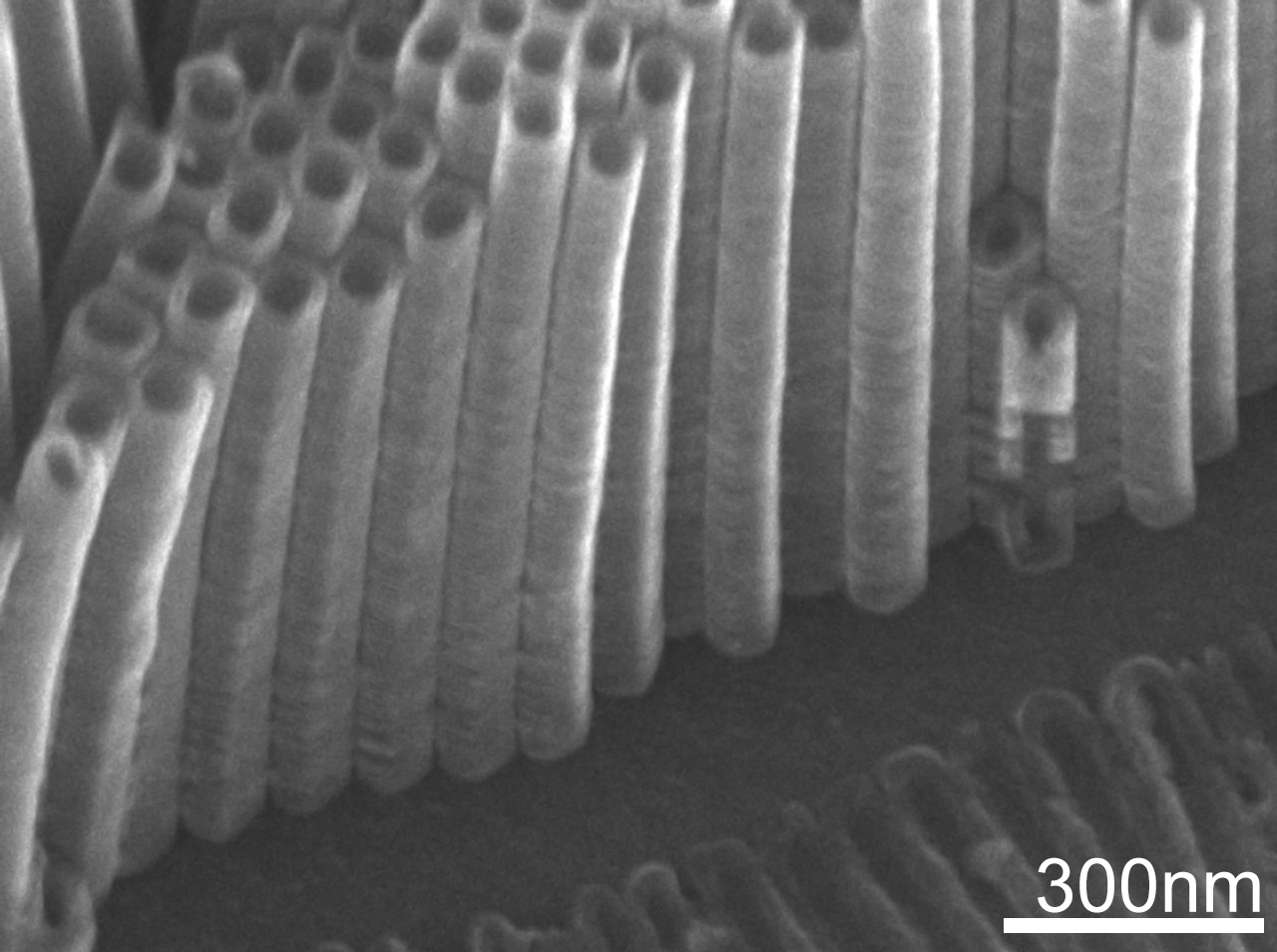
    Many studies, focused in TiO2 anodized, uses frequently a NH4F salt concentration from 0.3 – 0.5 wt% and the whole information about how voltage, time and even pH affects to nanotubes morphology, are effective just for these concentration range. It is known, increasing salt concentration, the electrolyte increases their conductivity and anodization speed (oxidation-dissolution) suffer also an increment and for a specifically concentration 1.2wt%, there is no data about morphology repercussions. A TiO2 nanotubular matrix is synthesized, in order to identify the range of time where it is possible to obtain with no presence of nanograss. The anodization process consists of an organic electrolyte of ethylene glycol, deionized water and 1.2 wt% NH4F salts, constant potential of 30 V and a time lapse from 10 to 60 minutes (short time). All anodized samples are rinsed and annealed to 400 °C by 4 hours to obtain an anatase crystalline structure; no samples are cleaned in ultrasonic bath to preserve the nanograss structure. Optical characterization was performed by Raman Spectroscopy to identify the increases in signal intensity, associated with thickness. The morphological characterization was carried out by Scanning Electron Microscopy to verify the presence and density of the nanograss and nanotubes.

    ⬇️ Scroll down to see the full summary
  • Axisymmetric modelling of transient thermal response in solids for application to infrared photothermal radiometry technique

    J. Hernández-Wong, J. B. Rojas-Trigos, U. Nogal, V. Suárez, E. Marín, Jose Antonio Calderon Arenas
    54-64
    Abstract:
    To induce temperature changes on the sample surface by the incidence of a monochromatic modulated light beam and detect the changes produced in the thermal radiation emission is the basic principle of the infrared photothermal radiometry technique. Until now, in order to analyze the thermal response mathematical models based in an one-dimensional model were used considering a sample with a finite thickness and an infinite incidence surface, as well as, the linear approximation of the Stefan-Boltzmann Law in the calculus of the heat losses due to thermal radiation. In this work, analytical and numerical models for the 2D heat diffusion in homogenous finite solid samples, are presented. These models were obtained by solving the heat diffusion equation, under cylindrical symmetry, considering mixed boundary conditions to include radiation and convection heat losses through the surfaces of the sample, and a monochromatic Gaussian excitation beam impinging on the front of the sample. The analytical models were obtained by solving the governing equations, considering the well-known linear approximation of the Stefan-Boltzmann law in the calculus of the heat losses due to thermal radiation. To analyse the effects of the non-linearity of the heat losses by thermal radiation on the thermal transient response, in the numerical model it was taken into account the full expression of the Stefan-Boltzmann law, and the transport equation was solved numerically by means of the Finite Element Method (FEM). The analytical solution for the oscillatory thermal response reveals the close dependence of the thermal response on the ratio of thickness to the radius of the sample, represented by the form factor sf. Both, the analytical and the numerical solutions were employed to simulate the thermal response of homogenous materials, and compared with experimental results reported elsewhere by part of our same research group. Finally, the difference between the thermal response predictions, from the analytical and numerical models, were analyzed.
    ⬇️ Scroll down to see the full summary

07 Gravitation, Mathematical Physics and Field Theory

  • The Riemann-Silberstein vector in the Dirac algebra

    Shahen Hacyan
    65-68
    Abstract:

    It is shown that the Riemann-Silberstein vector, defined as ${\bf E} + i{\bf B}$, appears naturally in the $SL(2,C)$ algebraic representation of the electromagnetic field. Accordingly, a compact form of the Maxwell equations is obtained in terms of Dirac matrices, in combination with the null-tetrad formulation of general relativity. The formalism is fully covariant; an explicit form of the covariant derivatives is presented in terms of the Fock coefficients.

    ⬇️ Scroll down to see the full summary
  • A SU(5)xZ2 kink solution and its local stability

    Rommel Guerrero, Rafael Omar Rodriguez, Rafael Alejandro Chavez
    69-72
    Abstract:

    A non-abelian kink inducing asymptotically the breaking pattern $SU(5)\times Z_2\rightarrow SU(4)\times U(1)/Z_4$ is obtained. We consider a fourth order Higgs potential in a $1+1$ theory where the scalar field is in the adjoint representation of $SU(5)$.
    The perturbative stability of the kink also is evaluated. A Schr\"odinger-like equation for the excitations along each $SU(5)$ generator is determined and in none of the cases negative eigenvalues compromising the stability of solution are found. In particular, several bounded scalar states are determined among them the translational zero mode of the flat space $SU(5)\times Z_2$ kink.

    ⬇️ Scroll down to see the full summary
  • Optical soliton solutions of the Ginzburg-Landau equation with conformable derivative and Kerr law nonlinearity

    Behzad Ghanbari, Francisco Gomez
    73-81
    Abstract:
    By using the generalized exponential rational function method we obtain new periodic and hyperbolic soliton solutions for the conformable Ginzburg-Landau equation with Kerr law nonlinearity. The conformable derivative was considered to obtain the exact solutions under constraint conditions. To determine the solution of the model, the method uses the generalization of the exponential rational function method. Numerical simulations are performed to confirm the efficiency of the proposed method.
    ⬇️ Scroll down to see the full summary
  • Analytical solution of the time fractional diffusion equation and fractional convection-diffusion equation

    Francisco Gomez, Victor Morales, Marco Taneco
    82-88
    Abstract:
    In this paper, we obtain analytical solutions for the time-fractional diffusion and time-fractional convection-diffusion equations. These equations are obtained from the standard equations by replacing the time derivative with a fractional derivative of order $\alpha$. Fractional operators of type Liouville-Caputo, Atangana-Baleanu-Caputo, fractional conformable derivative in Liouville-Caputo sense and Atangana-Koca-Caputo were used to model diffusion and convection-diffusion equation. The Laplace and Fourier transforms were applied to obtain the analytical solutions for the fractional order diffusion and convection-diffusion equations. The solutions obtained can be useful to understand the modeling of anomalous diffusive, subdiffusive systems and super-diffusive systems, transport processes, random walk and wave propagation phenomenon.
    ⬇️ Scroll down to see the full summary

09 Instrumentation

  • Low-cost Arduino-based interface for controlling gas flow in chemical vapor deposition graphene synthesis

    Laura Natalia Serkovic-Loli, Axel Ricardo Rodríguez-Gómez, Jesús Abimael López Castillo, Rodrigo Alejandro Gutiérrez-Arenas
    89-94
    Abstract:
    In this work, we present a low-cost computer controlled, Arduino-based automation of the mass flow controllers for a chemical vapor deposition system. The major goal of the system is to provide the possibility to produce flow ramps of several gases for material synthesis. We used an Arduino Due board that only has the possibility to control two signals and increased this with a multiplexor so we could control 4 signals. The control board is based on the Arduino open source electronics prototyping platform, Labview software and Matlab's Simulink software. We quantify the quality of our automation system by comparing the Raman spectra of our graphene samples obtained after using our Arduino system, the manual method and using a National Instrument board. The results are very good as our 50 dollars system show similar results with the National Instrument system and the manual method.
    ⬇️ Scroll down to see the full summary

13 Optics

  • Absorbancia y reflectancia de hojas de Ficus contaminadas con nanopartículas de plata

    Laura Peña, Víctor Rentería, Celso Velásquez, Maria Luisa Ojeda, Enrique Barrera
    95-105
    Abstract:

    En este trabajo se informa la preparación de nanopartículas de plata esféricas dispersadas en agua con distribución de tamaño bimodal (diámetro promedio de 1.8 y 44 nm), las cuales son depositadas sobre la superficie de hojas de Ficus benjamina por el método de inmersión. El efecto de las nanopartículas en la absorbancia y la reflectancia en la superficie adaxial de las hojas es investigado con respecto a las hojas sin contaminar, en la región de 200 a 2000 nm. La absorbancia de las hoja contaminada disminuyó en la región del UV, donde predominan absorciones de péptidos, quininas y flavonoides. La absorbancia relacionada con pigmentos fotosintéticos fue prácticamente constante en la región del visible (< 700 nm). En la región de 730 a 780 nm aparece un pequeño incremento en la absorción óptica relacionada con la aparición de un color pardo en la hoja estresada. Para longitudes de onda del infrarrojo cercano, las absorciones ópticas debido a agua (máximos en 1194, 1458 y 1940) se incrementaron, sugiriendo un proceso de infiltración de ésta molécula en la estructura interna de la hoja. Por otra parte, las hojas reflejan muy poca luz en la región UV-Vis debido a que sus pigmentos absorben luz en esta región. Una débil disminución de la reflectancia en el verde (554 nm) proviene de oxidación de polifenoles. El daño causado a las hojas por el estrés inducido, se confirmó por una disminución evidente de la reflectancia para longitudes de onda entre 730 y 820 nm. Mientras que la reflectancia en el intervalo de 840 a 1070 nm alcanzó valores tan altos como 96 % en la hoja contaminada.  Finalmente, la baja reflectancia observada en la región de 1190 a 2000 nm se relacionó con la absorción de radiación por agua. Respecto a la morfología de las nanopartículas de plata, se observó que tienden a formar agregados sobre la superficie adaxial de la hoja de Ficus. La metodología propuesta constituye un modelo simple, que podría explicar cómo el material nanoparticulado existente en el entorno atmosférico o terrestre, es depositado sobre las hojas de las plantas e inferir los efectos de estrés por nanopartículas en los procesos de la transpiración, el balance térmico y la fotosíntesis.

    ⬇️ Scroll down to see the full summary