
Soliton solutions to the 3-dimensional KdV and modified 3-dimensional KdV equations
DOI:
https://doi.org/10.31349/RevMexFis.72.031302Keywords:
NLPDEs, Three-dimensional KdV, Modified Three-dimensional KdV, Tanh-Coth Method with Ricatti EquationAbstract
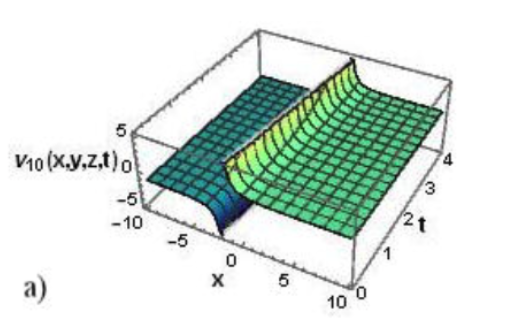
In this study, we successfully employed the Tanh-Coth method alongside the Riccati equation transformation to derive exact soliton solutions for both the three-dimensional Korteweg-de Vries (3D KdV) equation and its modified variant. This analytical approach enabled the systematic reduction of the complex nonlinear partial differential equations to solvable ordinary differential equations. By assuming a traveling wave transformation and expressing the solution in terms of hyperbolic tangent and hyperbolic cotangent functions, solutions of the Riccati equation, we obtained a variety of solitary wave profiles, including kink, anti-kink, and localized pulse solutions. Graphical representation for some of the obtained solutions is portrayed to show the nature of the kink, anti-kink and localized pulse solution in 3D, contours and 2D respectively, by choosing suitable values of parameters.
Downloads
References
G. Adomian, “Solving frontier problems of physics: the decomposition method”, 60, Springer Science and Business Media, (2013).
M. A. Akbar, N. H. J. Mohd, E. M. E. Zayed, “Generalized and Improved (G′/G)-Expansion Method Combined with Jacobi Elliptic Equation”, Commun. Theor. Phys. 61 (6), 669 (2014). DOI: https://doi.org/10.1088/0253-6102/61/6/02
A. Biswas, “1-soliton solution of the K (m, n) equation with generalized evolution”, Phys. Lett. A 372 (25), 4601-4602 (2008). DOI: https://doi.org/10.1016/j.physleta.2008.05.002
G. Ebadi, A. Biswas, “The G′/G method and topological soliton solution of the K(m, n) equation”, Commun. Nonlinear Sci. Numer. Simul. 16 (6), 2377-2382 (2011). DOI: https://doi.org/10.1016/j.cnsns.2010.09.009
Y. L. Feng, W.-R. Shan, W.-R. Sun, H. Zhong, B. Tian, “Bifurcation analysis and solutions of a three-dimensional Kudryashov–Sinelshchikov equation in the bubbly liquid”, Commun. Nonlinear Sci. Numer. Simul. 19 (4), 880-886 (2014). DOI: https://doi.org/10.1016/j.cnsns.2013.08.001
X.Y. Gao, “Density-fluctuation symbolic computation on the (3+1)-dimensional variable-coefficient Kudryashov–Sinelshchikov equation for a bubbly liquid with experimental support”, Mod. Phys. Lett. B 30 (15), 1650217 (2016). DOI: https://doi.org/10.1142/S0217984916502171
A. Goriely, “Integrability and nonintegrability of dynamical systems”, 19, World Scientific, (2001). DOI: https://doi.org/10.1142/3846
O. Guner, A. Bekir, H. Bilgil, “A note on exp-function method combined with complex transform method applied to fractional differential equations”, Adv. Nonlinear Anal. 4 (3), 201–208 (2015). DOI: https://doi.org/10.1515/anona-2015-0019
Z. Jun-Yi, G. Xian-Guo, “Miura transformation for the TD hierarchy”, Chin. Phys. Lett. 23 (1), 1 (2006). DOI: https://doi.org/10.1088/0256-307X/23/1/001
M. Kaplan, A. Bekir, A. Akbulut, E. Aksoy, “The modified simple equation method for nonlinear fractional differential equations”, Rom. J. Phys. 60 (9-10), 1374–1383.
N. A. Kudryashov, D. I. Sinelshchikov, “Equation for the threedimensional nonlinear waves in liquid with gas bubbles”, Physica Scripta 85 (2), 025402 (2012). DOI: https://doi.org/10.1088/0031-8949/85/02/025402
Y. Sun, B. Tian, X.Y. Wu, L. Liu, Y.Q. Yuan, “Dark solitons for a variable-coefficient higher-order nonlinear Schr¨odinger equation in the inhomogeneous optical fiber”, Mod. Phys. Lett. B 31 (12), 1750065 (2017). DOI: https://doi.org/10.1142/S0217984917500658
H. Triki, A. M. Wazwaz, “Bright and dark soliton solutions for a K (m,n) equation with t-dependent coefficients”, Phys. Lett. A 373 (25), 2162–2165 (2009). DOI: https://doi.org/10.1016/j.physleta.2009.04.029
A. M. Wazwaz, “New solitons and kink solutions for the Gardner equation”, Commun. Nonlinear Sci. Numer. Simul. 12 (8), 1395–1404 (2007). DOI: https://doi.org/10.1016/j.cnsns.2005.11.007
A. M. Wazwaz, “Partial differential equations and solitary waves theory”, Springer Science and Business Media, (2010). DOI: https://doi.org/10.1007/978-3-642-00251-9
A. M. Wazwaz, “The extended tanh method for new solitons solutions for many forms of the fifth-order KdV equations”, Appl. Math. Comput. 184 (2), 1002–1014 (2007). DOI: https://doi.org/10.1016/j.amc.2006.07.002
L. Wazzan, “A modified tanh–coth method for solving the KdV and the KdV–Burgers’ equations”, Commun. Nonlinear Sci. Numer. Simul. 14 (2), 443–450 (2009).
L. V. Wijngaarden, “On the equations of motion for mixtures of liquid and gas bubbles”, Journal of Fluid Mechanics 33 (3), 465–474 (1968). DOI: https://doi.org/10.1017/S002211206800145X
M. J. Xu, S. F. Tian, J. M. Tu, T. T. Zhang, “B¨acklund transformation, infinite conservation laws and periodic wave solutions to a generalized (2+ 1)-dimensional Boussinesq equation”, Nonlinear Analysis: Real World Applications 31, 388–408 (2016). DOI: https://doi.org/10.1016/j.nonrwa.2016.01.019
H. Y´epez-Mart´ınez, F. G´omez-Aguilar, I. Sosa, J. Reyes, J. Torres-Jim´enez, “The Feng’s first integral method applied to the nonlinear mKdV space-time fractional partial differential equation”, Rev. Mex. Fis. 62 (4), 310–316 (2016).
E. M. E. Zayed, K. A. E. Alurrfi, “A new Jacobi elliptic function expansion method for solving a nonlinear PDE describing the nonlinear low-pass electrical lines Chaos”, Solitons Fractals 78, 148–155 (2015). DOI: https://doi.org/10.1016/j.chaos.2015.07.018
S. Zhang, “Exp-function method exactly solving a KdV equation with forcing term”, Appl. Math. Comput. 197 (1), 128–134 (2008). DOI: https://doi.org/10.1016/j.amc.2007.07.041
L.Wazzan, “A modified tanh-cothmethod for solving the KDV and the KDV-BUrgers’ equations,” Communications in NonlinearScience and Numerical Simulation, 14 (2), 443–450 (2009). DOI: https://doi.org/10.1016/j.cnsns.2007.06.011
Chukkol, Y.B., Muminov, M., “Bright and Dark Soliton Solutions of Three-Dimensional KdV and mKdV Equations in Inviscid Liquid with Gas Bubbles”, Int. Jrn. Of Math. and Cpt. Sc 15 (1), 253–264 (2020).
Downloads
Published
How to Cite
Issue
Section
License
Copyright (c) 2026 A. Danladi, A. Tahir, H. Rezazadeh, M. Ali Hosseinzadeh, S. Salahshour

This work is licensed under a Creative Commons Attribution-NonCommercial-NoDerivatives 4.0 International License.
Authors retain copyright and grant the Revista Mexicana de Física right of first publication with the work simultaneously licensed under a CC BY-NC-ND 4.0 that allows others to share the work with an acknowledgement of the work's authorship and initial publication in this journal.