
A brief study concerning thermal transport properties of B-C-N monolayers and graphene/X nanoribbon heterojunctions: Influences of carbon concentration and mean temperature
DOI:
https://doi.org/10.31349/RevMexFis.72.051001Keywords:
B-C-Nmonolayers, graphene-based nanoribbon heterojunctions, thermal transport properties, NEMD simulationsAbstract
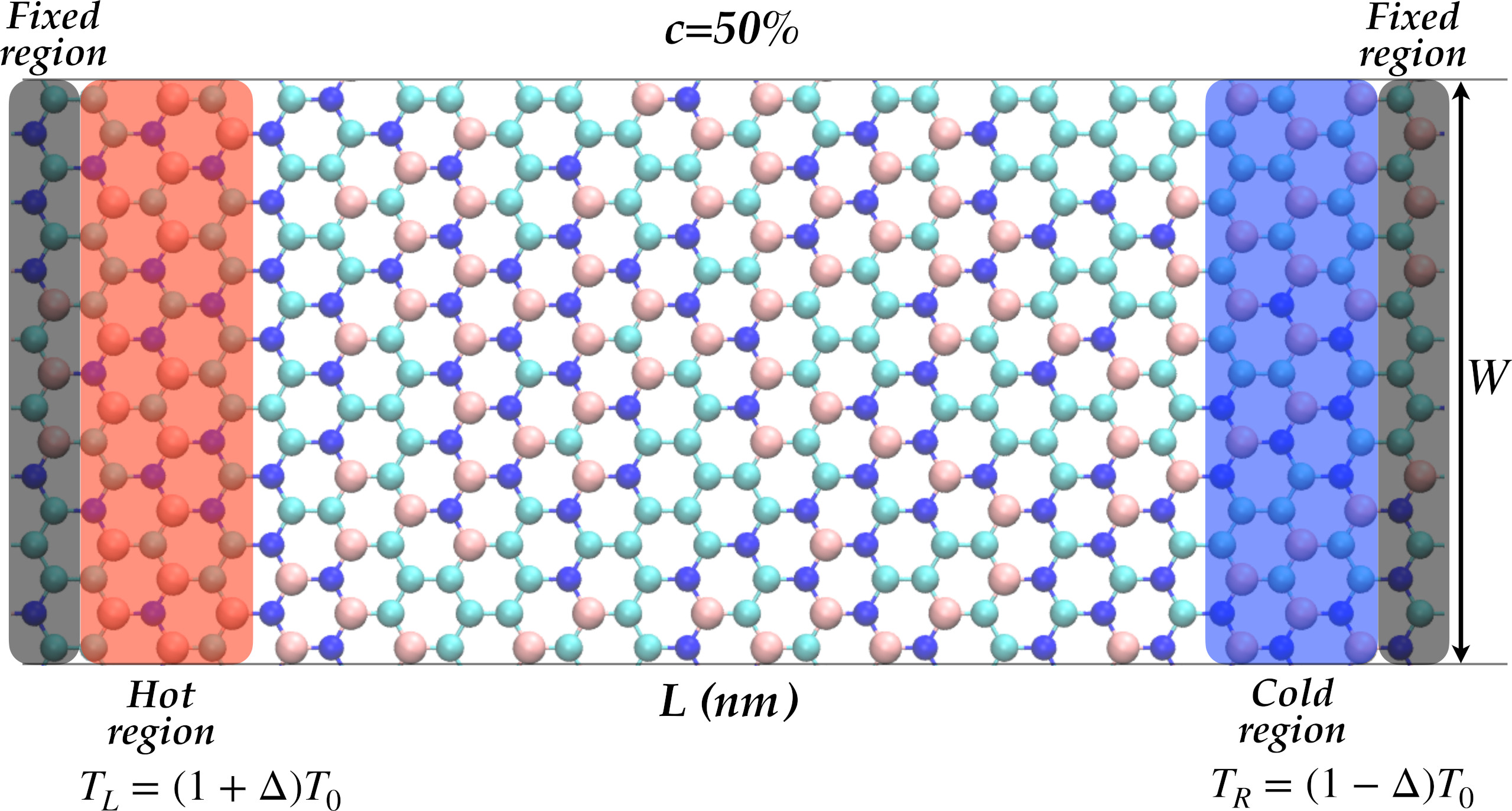
A wide variety of two-dimensional (2D) materials provide an optional route for manipulating heat fluxes at the nanoscale. Nowadays, 2D carbon-based materials have received important attention due to their adjustable transport properties by a controlled tuning of composition, junction, geometry, etc. In the present paper, we address the thermal transport properties of the B-C-N (Boron-Carbon-Nitride) monolayers and graphene/X (X=hBN, hSiC, and graphane) nanoribbon heterojunctions by performing non-equilibrium molecular dynamics simulations. Our results show that the carbon concentration modifies the thermal conductivity of B-C-N monolayers at a mean temperature of 300 K, producing values of 29.47, 28.94, and 16.58 W/m−K for concentrations of 90, 10, and 50%, respectively. Nevertheless, no major effect of carbon concentration on the temperature profile of B-C-N monolayers is observed. On the other hand, the mean temperature influences the interface thermal resistance and thermal conductivity of coplanar graphene/X nanoribbon heterojunctions, these variations are observed for the forward direction of the heat flux, modulating the temperature drop at the interface. Besides, graphene/hBN and graphene/graphane heterojunctions show a pronounced thermal rectification at a mean temperature below 300 K, compared to graphene/hSiC heterojunction. In which the heat fluxes present an asymmetry in the $j−\Delta$ curve, highlighting that the heat flux in the backward direction preferentially flows from X (hBN and graphane) to graphene nanoribbons.
Downloads
References
V. Sharma et al., Thermal transport properties of boron nitride based materials: A review, Renewable and Sustainable Energy Reviews 120 (2020) 109622, https://doi.org/10.1016/j.rser.2019.109622 DOI: https://doi.org/10.1016/j.rser.2019.109622
D. Gupta, V. Chauhan, and R. Kumar, A comprehensive review on synthesis and applications of molybdenum disulfide (MoS2) material: Past and recent developments, Inorganic Chemistry Communications 121 (2020) 108200, https://doi.org/10.1016/j.inoche.2020.108200 DOI: https://doi.org/10.1016/j.inoche.2020.108200
T. Rasheed, MXenes as an emerging class of two-dimensional materials for advanced energy storage devices, Journal of Materials Chemistry A 10 (2022) 4558, https://doi.org/10.1039/D1TA10083A DOI: https://doi.org/10.1039/D1TA10083A
M. Tahir et al., A review on the 2D black phosphorus materials for energy applications, Inorganic Chemistry Communications 124 (2021) 108242, https://doi.org/10.1016/j.inoche.2020.108242 DOI: https://doi.org/10.1016/j.inoche.2020.108242
N. R. Glavin et al., Emerging applications of elemental 2D materials, Advanced Materials 32 (2020) 1904302, https://doi.org/10.1002/adma.201904302 DOI: https://doi.org/10.1002/adma.201904302
S. Angizi et al., Two-dimensional boron carbon nitride: a comprehensive review, ECS Journal of Solid State Science and Technology 9 (2020) 083004, https://doi.org/10.1149/2162-8777/abb8ef DOI: https://doi.org/10.1149/2162-8777/abb8ef
F. Wu et al., High thermal conductivity 2D materials: From theory and engineering to applications, Advanced Materials Interfaces 9 (2022) 2200409, https://doi.org/10.1002/admi.202200409 DOI: https://doi.org/10.1002/admi.202200409
S. Beniwal et al., Graphene-like boron-carbon-nitrogen monolayers, ACS nano 11 (2017) 2486, https://doi.org/10.1021/acsnano.6b08136 DOI: https://doi.org/10.1021/acsnano.6b08136
L. Cheng et al., Two-dimensional hexagonal boron-carbon- nitrogen atomic layers, Nanoscale 11 (2019) 10454, https://doi.org/10.1039/C9NR00712A DOI: https://doi.org/10.1039/C9NR00712A
R. Attri et al., Low thermal conductivity of 2D borocarbonitride nanosheets, Journal of Solid State Chemistry 282 (2020) 121105, https://doi.org/10.1016/j.jssc.2019.121105 DOI: https://doi.org/10.1016/j.jssc.2019.121105
S. Nappini et al., Chemical composition and interaction strength of two-dimensional boron-nitrogen-carbon heterostructures driven by polycrystalline metallic surfaces, Applied Surface Science 479 (2019) 903, https://doi.org/10.1016/j.apsusc.2019.01.274 DOI: https://doi.org/10.1016/j.apsusc.2019.01.274
F. Leardini et al., A fast synthesis route of boron-carbonnitrogen ultrathin layers towards highly mixed ternary B-CN phases, 2D Materials 6 (2019) 035015, https://doi.org/10.1088/2053-1583/ab175c DOI: https://doi.org/10.1088/2053-1583/ab175c
S. Thomas and S. U. Lee, Atomistic insights into the anisotropic mechanical properties and role of ripples on the thermal expansion of h-BCN monolayers, RSC advances 9 (2019) 1238, https://doi.org/10.1039/C8RA08076C DOI: https://doi.org/10.1039/C8RA08076C
L. Jiao et al., Electronic, elastic, and optical properties of monolayer BC2N, Journal of Solid State Chemistry 244 (2016) 120, https://doi.org/10.1016/j.jssc.2016.09.012 DOI: https://doi.org/10.1016/j.jssc.2016.09.012
M. Kaur et al., Recent insights into BCN nanomaterials- synthesis, properties and applications, New Journal of Chemistry 47 (2023) 2137, https://doi.org/10.1039/D2NJ04763B DOI: https://doi.org/10.1039/D2NJ04763B
Z. Zhang et al., Thermal transport in MoS2/Graphene hybrid nanosheets, Nanotechnology 26 (2015) 375402, https://doi.org/10.1088/0957-4484/26/37/375402 DOI: https://doi.org/10.1088/0957-4484/26/37/375402
X.-K. Chen et al., Thermal rectification and negative differential thermal resistance behaviors in graphene/hexagonal boron nitride heterojunction, Carbon 100 (2016) 492, https://doi.org/10.1016/j.carbon.2016.01.045 DOI: https://doi.org/10.1016/j.carbon.2016.01.045
Y. Hong, J. Zhang, and X. C. Zeng, Thermal contact resistance across a linear heterojunction within a hybrid graphene/hexagonal boron nitride sheet, Physical Chemistry Chemical Physics 18 (2016) 24164, https://doi.org/10.1039/C6CP03933B DOI: https://doi.org/10.1039/C6CP03933B
L. M. Sandonas et al., Enhancement of thermal transport properties of asymmetric Graphene/hBN nanoribbon heterojunctions by substrate engineering, Carbon 124 (2017) 642, https://doi.org/10.1016/j.carbon.2017.09.025 DOI: https://doi.org/10.1016/j.carbon.2017.09.025
B. Liu et al., Interface thermal conductance and rectification in hybrid graphene/silicene monolayer, Carbon 79 (2014) 236, https://doi.org/10.1016/j.carbon.2014.07.064 DOI: https://doi.org/10.1016/j.carbon.2014.07.064
J. Zhou et al., Phonon thermal transport in silicene/graphene heterobilayer nanostructures: Effect of interlayer interactions, ACS omega 7 (2022) 5844, https://doi.org/10.1021/acsomega.1c05932 DOI: https://doi.org/10.1021/acsomega.1c05932
X. Liu et al., MoS 2-graphene in-plane contact for high interfacial thermal conduction, Nano Research 10 (2017) 2944, https://doi.org/10.1007/s12274-017-1504-8 DOI: https://doi.org/10.1007/s12274-017-1504-8
A. Rajabpour, S. Vaez Allaei, and F. Kowsary, Interface thermal resistance and thermal rectification in hybrid graphenegraphane nanoribbons: A nonequilibrium molecular dynamics study, Applied Physics Letters 99 (2011), https://doi.org/10.1063/1.3622480 DOI: https://doi.org/10.1063/1.3622480
B. Liu et al., Morphology and in-plane thermal conductivity of hybrid graphene sheets, Applied Physics Letters 101 (2012), https://doi.org/10.1063/1.4767388 DOI: https://doi.org/10.1063/1.4767388
Y.-Y. Zhang et al., Interfacial thermal conductance in multilayer graphene/phosphorene heterostructure, Journal of Physics D: Applied Physics 49 (2016) 465301, https://doi.org/10.1088/0022-3727/49/46/465301 DOI: https://doi.org/10.1088/0022-3727/49/46/465301
S. Zhao, Y. Zhou, and H. Wang, Review of thermal rectification experiments and theoretical calculations in 2D materials, International Journal of Heat and Mass Transfer 195 (2022) 123218, https://doi.org/10.1016/j.ijheatmasstransfer.2022.123218 DOI: https://doi.org/10.1016/j.ijheatmasstransfer.2022.123218
W. Zheng et al., Understanding and engineering interfacial thermal conductance of two-dimensional materials, Surfaces and Interfaces (2023) 103538, https://doi.org/10.1016/j.surfin.2023.103538 DOI: https://doi.org/10.1016/j.surfin.2023.103538
S. Plimpton, Fast Parallel Algorithms for Short-Range Molecular Dynamics, Journal of Computational Physics 117 (1995) 1, https://doi.org/10.1006/jcph.1995.1039 DOI: https://doi.org/10.1006/jcph.1995.1039
S. Chabi and K. Kadel, Two-dimensional silicon carbide: emerging direct band gap semiconductor, Nanomaterials 10 (2020) 2226, https://doi.org/10.3390/nano10112226 DOI: https://doi.org/10.3390/nano10112226
A. Kınacıet al., Thermal conductivity of BN-C nanostructures, Physical Review B 86 (2012) 115410, https://doi.org/10.1103/PhysRevB.86.115410 DOI: https://doi.org/10.1103/PhysRevB.86.115410
Y.-Y. Zhang et al., A molecular dynamics study of the mechanical properties of h-BCN monolayer using a modified Tersoff interatomic potential, Physics Letters A 383 (2019) 2821, https://doi.org/10.1016/j.physleta.2019.05.055 DOI: https://doi.org/10.1016/j.physleta.2019.05.055
J. Tersoff, Modeling solid-state chemistry: Interatomic potentials for multicomponent systems, Physical review B 39 (1989) 5566, https://doi.org/10.1103/PhysRevB.39.5566 DOI: https://doi.org/10.1103/PhysRevB.39.5566
S. J. Stuart, A. B. Tutein, and J. A. Harrison, A reactive potential for hydrocarbons with intermolecular interactions, The Journal of chemical physics 112 (2000) 6472, https://doi.org/10.1063/1.481208 DOI: https://doi.org/10.1063/1.481208
Q. Liang and Y. Wei, Molecular dynamics study on the thermal conductivity and thermal rectification in graphene with geometric variations of doped boron, Physica B: Condensed Matter 437 (2014) 36, https://doi.org/10.1016/j.physb.2013.12.035 DOI: https://doi.org/10.1016/j.physb.2013.12.035
F. K. Malik and K. Fobelets, A review of thermal rectification in solid-state devices, Journal of Semiconductors 43 (2022) 103101, https://doi.org/10.1088/1674-4926/43/10/103101 DOI: https://doi.org/10.1088/1674-4926/43/10/103101
Y.-Y. Zhang et al., Thermal conductivity of a h-BCN monolayer, Physical Chemistry Chemical Physics 19 (2017) 27326, https://doi.org/10.1039/C7CP04982J DOI: https://doi.org/10.1039/C7CP04982J
P. R. Galligan et al., Aligned carbon-doping to modulate thermal and electrical conductivity of boron carbon nitride grown from chemical vapor deposition, Carbon 215 (2023) 118397, https://doi.org/10.1016/j.carbon.2023.118397 DOI: https://doi.org/10.1016/j.carbon.2023.118397
Y. Xian et al., Experimental characterization methods for thermal contact resistance: A review, Applied Thermal Engineering 130 (2018) 1530, https://doi.org/10.1016/j.applthermaleng.2017.10.163 DOI: https://doi.org/10.1016/j.applthermaleng.2017.10.163
H. Ding et al., A review from fundamental research to device applications for graphene-based thermal rectifier, DeCarbon 4 (2024) 100048, https://doi.org/10.1016/j.decarb.2024.100048 DOI: https://doi.org/10.1016/j.decarb.2024.100048
X.-K. Chen et al., A wave-dominated heat transport mechanism for negative differential thermal resistance in graphene/hexagonal boron nitride heterostructures, Applied Physics Letters 110 (2017), https://doi.org/10.1063/1.4977776 DOI: https://doi.org/10.1063/1.4977776
A. Joshi and C. Ramachandran, High-bias negative differential resistance effect in pure, doped and co-doped carbon nanotubes connected to boron nitride nanotubes, Physica E: Low-Dimensional Systems and Nanostructures 113 (2019) 1, https://doi.org/10.1016/j.physe.2019.04.021 DOI: https://doi.org/10.1016/j.physe.2019.04.021
Downloads
Published
How to Cite
Issue
Section
License
Copyright (c) 2026 Gustavo Cuba-Supanta, Melquicedec Martinez Rios, Chachi Rojas Ayala, Justo Rojas Tapia

This work is licensed under a Creative Commons Attribution-NonCommercial-NoDerivatives 4.0 International License.
Authors retain copyright and grant the Revista Mexicana de Física right of first publication with the work simultaneously licensed under a CC BY-NC-ND 4.0 that allows others to share the work with an acknowledgement of the work's authorship and initial publication in this journal.