
The effect of the linker group between porphyrin dimers on the thermoelectric properties of molecular junctions
DOI:
https://doi.org/10.31349/RevMexFis.72.030401Keywords:
Dimer porphyrin; zinc metal ion; (DFT) method; the thermoelectric figure of merit (ZT)Abstract
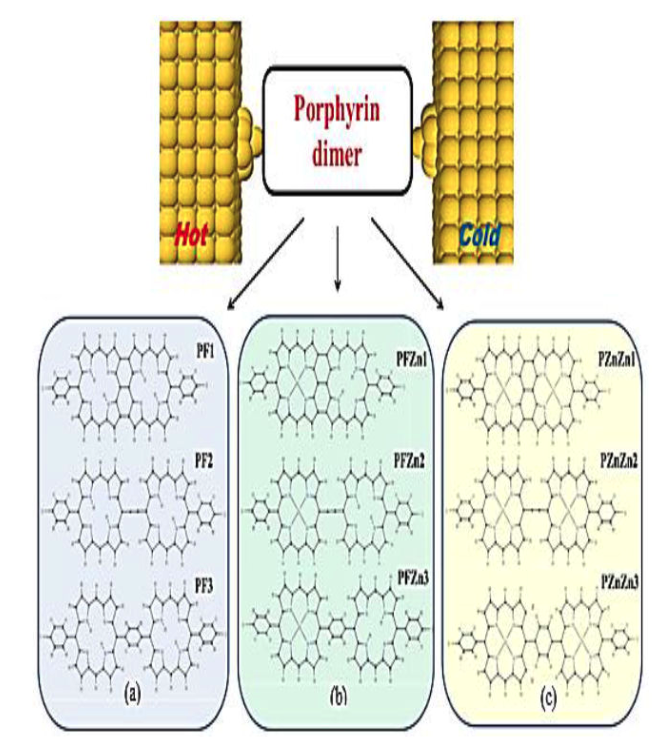
The effect of the appearance of three different linkers between dimer porphyrins on the electronic and thermoelectric properties of three different dimer porphyrin families’ molecular junctions was investigated theoretically using a combination of density functional theory (DFT) methods. Our results show that in the free-based porphyrin dimer family, all electronic and thermoelectric properties have been affected by using different linkers between porphyrin dimers. While in the presence of one zinc metal ion in the center of the porphyrin dimer and the two zinc metal ion in the center of porphyrin dimer families, the results demonstrate that the electronic and thermal conductance is highly affected by the presence of three different linkers between these dimers. On the other hand, the thermopower of all other structures shows noticeable change, especially around the Fermi energy. Thus, the gradual appearance of zinc ion in the center of porphyrin dimer units with three different linkers between these dimers plays an essential role in these structures’ electric and thermal properties.
Downloads
References
P. Reddy, S. Y. Jang, R. A. Segalman, A. Majumdar, Thermoelectricity in molecular junctions. Science. 315 (2007) 1568-71. https://doi.org/10.1126/science.1137149 DOI: https://doi.org/10.1126/science.1137149
L. Cui, R. Miao, C. Jiang, E. Mehofer, P. Reddy, Perspective: Thermal and thermoelectric transport in molecular junctions. J Chemical Physics. 146 (2017) 092201. https://doi.org/10.1063/1.4976982 DOI: https://doi.org/10.1063/1.4976982
H. Xu et al., Electrical Conductance and Thermopower of β-Substituted Porphyrin Molecular Junctions- Synthesis and Transport. J. American Chemical Society, 145 (2023) 23541- 23555. https://doi.org/10.1021/jacs.3c07258 DOI: https://doi.org/10.1021/jacs.3c07258
J. Jang, P. He, H. Yoon. Molecular thermoelectricity in EGaInbased molecular junctions. Accounts of Chemical Research. 56 (2023) 1613-1622. https://doi.org/10.1021/acs.accounts.3c00168 DOI: https://doi.org/10.1021/acs.accounts.3c00168
M. Di Domenico, I. Carlomagno, A. Sellitto, Wave propagation at nano-scale in coupled transport phenomena: application to thermoelectricity. Meccanica, 59 (2024) 1685-1701. https://doi.org/10.1007/s11012-024-01777-3 DOI: https://doi.org/10.1007/s11012-024-01777-3
M. Samanta, S. Kundu, D. Mitra, Thermoelectric Effects. Thermoelectric Polymers: Properties and Applications, 162 (2024) 1-23. ISBN: 978-1-64490-300-1 DOI: https://doi.org/10.21741/9781644903018-1
D. Cotfas, A. Enesca, P. Cotfas. Enhancing the performance of the solar thermoelectric generator in unconcentrated and concentrated light. Renewable Energy, 221 (2024) 119831. https://doi.org/10.1016/j.renene.2023.119831 DOI: https://doi.org/10.1016/j.renene.2023.119831
D. Luo, Y. Yan, W. Chen, B. Cao. Exploring the dynamic characteristics of thermoelectric generator under fluctuations of exhaust heat. International Journal of Heat and Mass Transfer, 222 (2024) 125151. https://doi.org/10.1016/j.ijheatmasstransfer.2023.125151 DOI: https://doi.org/10.1016/j.ijheatmasstransfer.2023.125151
W. Yang et al., Taguchi optimization and thermoelectrical analysis of a pin fin annular thermoelectric generator for automotive waste heat recovery. Renewable Energy, 220 (2024) 119628. https://doi.org/10.1016/j.renene.2023.119628 DOI: https://doi.org/10.1016/j.renene.2023.119628
D. Yousri, A. Fathy, H. Farag, E. El-Saadany. Optimal dynamic reconfiguration of thermoelectric generator array using RIME optimizer to maximize the generated power. Applied Thermal Engineering, 238 (2024) 122174. https://doi.org/10.1016/j.applthermaleng.2023.122174 DOI: https://doi.org/10.1016/j.applthermaleng.2023.122174
P. Alegría, L. Catalan, M. Araiz, I. Erro, D. Astrain. Design and optimization of thermoelectric generators for harnessing geothermal anomalies: A computational model and validation with experimental field results. Applied Thermal Engineering, 236 (2024) 121364. https://doi.org/10.1016/j.applthermaleng.2023.121364 DOI: https://doi.org/10.1016/j.applthermaleng.2023.121364
R. E. Dong et al., Numerical modeling of a novel hybrid system composed of tubiform solid oxide fuel cell and segmented annular thermoelectric generator (SOFC/SATEG). Applied Thermal Engineering, 243 (2024) 122706. https://doi.org/10.1016/j.applthermaleng.2024.122706 DOI: https://doi.org/10.1016/j.applthermaleng.2024.122706
T. J. Seebeck, A. Octtingen, Magnetische polarisation der metalle und erze durch temperatur-differenz. (1895) Leipzig: W. Engelmann
T. Bennett, Synthesis and characterisation of novel molecular wires for studies of thermoelectricity. PhD thesis, (2022), Imperial College London. UK. https://doi.org/10.25560/99865
O. Albeydani, Theoretical study of vertical van der Walls metal-porphyrin and metal free-porphyrin junctions. Physica Scripta. 98 (2023) 085403. https://doi.org/10.1088/1402-4896/ace222 DOI: https://doi.org/10.1088/1402-4896/ace222
A. Al-Jobory, M. Noori, Thermoelectric properties of metallocene derivative single-molecule junctions. J Electronic Materials, 49 (2020) 5455-5459. https://doi.org/10.1007/s11664-020-08279-4 DOI: https://doi.org/10.1007/s11664-020-08279-4
W. Ma, Preparation and performance analysis of electrochemically assisted molecular electronic devices. International Journal of Electrochemical Science, 19 (2024) 100489. https://doi.org/10.1016/j.ijoes.2024.100489 DOI: https://doi.org/10.1016/j.ijoes.2024.100489
D. Vuillaume, Beyond-CMOS: state of the art and trends. Molecular Electronics: Electron, (2023) 251. ISBN: 978-1- 394-22870-6 DOI: https://doi.org/10.1002/9781394228713.ch7
M. Yuan, Y. Qiu, H. Gao, J. Feng, Y. Wu, Molecular electronics: from nanostructure assembly to device integration. J American Chemical Society, 146 (2024) 7885-7904. https://doi.org/10.1021/jacs.3c14044 DOI: https://doi.org/10.1021/jacs.3c14044
C. Yan et al., From Molecular Electronics to Molecular Intelligence. ACS nano, 18 (2024) 28531-28556. https://doi.org/10.1021/acsnano.4c10389 DOI: https://doi.org/10.1021/acsnano.4c10389
B. Yadav, M. Ravikanth. Porphyrinoid framework embedded with polycyclic aromatic hydrocarbons: new synthetic marvels. Organic & Biomolecular Chemistry, 22 (2024) 1932- 1960. https://doi.org/10.1039/D3OB02116E DOI: https://doi.org/10.1039/D3OB02116E
F. Santanni, A. Privitera. Metalloporphyrins as building blocks for quantum information science. Advanced Optical Materials, 12 (2024) 2303036. https://doi.org/10.1002/adom.202303036 DOI: https://doi.org/10.1002/adom.202303036
M. Noori et al., Tuning the electrical conductance of metalloporphyrin supramolecular wires. Sci Rep. 6 (2016) 37352. https://doi.org/10.1038/srep37352 DOI: https://doi.org/10.1038/srep37352
M. Mathius, Synthesis of Highly Conjugated Porphyrinoid Systems. Master thesis, (2022). Illinois State University. United States. https://doi.org/10.30707/ETD2022.20221020070312747424.999980 DOI: https://doi.org/10.30707/ETD2022.20221020070312747424.999980
A. S. Estrada-Montaño et al., Metalloporphyrins: Ideal catalysts for olefin epoxidations. J Porphyrins and Phthalocyanines, 26 (2022) 821-836. https://doi.org/10.1142/S1088424622300051 DOI: https://doi.org/10.1142/S1088424622300051
V. Singh, P. Thakur, V. Ganesan, M. Sanker.Zn (II) porphyrinbased polymer facilitated electrochemical synthesis of green hydrogen peroxide. Journal of Electroanalytical Chemistry, 919 (2022) 116536. https://doi.org/10.1016/j.jelechem.2022.116536 DOI: https://doi.org/10.1016/j.jelechem.2022.116536
C. Hahn da Silveira, A. Otavio, C. Amanda, M. Nathalia, L. Costa, A. Bernaldo, Synthesis, photophysics, computational approaches, and biomolecule interactive studies of metalloporphyrins containing pyrenyl units: Influence of the metal center. European J Inorganic Chemistry, (12) (2022) e202200075. https://doi.org/10.1002/ejic.202200075 DOI: https://doi.org/10.1002/ejic.202200075
N. Magdaong et al., Photophysical Properties and Electronic Structure of Zinc(II) Porphyrins Bearing 0-4 meso-Phenyl Substituents: Zinc Porphine to Zinc Tetraphenylporphyrin (ZnTPP). J Phys Chem A. 124 (2020) 7776-7794. https://doi.org/10.1021/acs.jpca.0c0684 DOI: https://doi.org/10.1021/acs.jpca.0c06841
Y. F. Liu, M. Juan, S. Kristian, Computational investigation of acene-modified zinc-porphyrin based sensitizers for dyesensitized solar cells. J Physical Chemistry C, 119 (2015) 8417- 8430. https://doi.org/10.1039/C3CP54050B DOI: https://doi.org/10.1021/jp507746p
X. Yu et al., A new A3B zinc (II)-porphyrin ligand and its ruthenium (II) complex: Synthesis, photophysical properties and photocatalytic applications. J Molecular Structure, 1237 (2021) 130358. https://doi.org/10.1016/j.molstruc.2021.130358 DOI: https://doi.org/10.1016/j.molstruc.2021.130358
P. J. Low, S. Marques-Gonzalez,, Molecular wires: an overview of the building blocks of molecular electronics. Single-Molecule Electronics: An Introduction to Synthesis, Measurement and Theory, (2016) 87-116. https://doi.org/10.1007/978-981-10-0724-8 DOI: https://doi.org/10.1007/978-981-10-0724-8_4
A. Al-mebir, S. AL-Saidi, Tuning Optoelectronic Properties of Double Quantum Dot Structure Using Tight-Binding Model for Photo-Electric Applications. NeuroQuantology, 19 (2021) 1. https://doi.org/10.14704/nq.2021.19.3.NQ21021 DOI: https://doi.org/10.14704/nq.2021.19.3.NQ21021
S. AL-Saidi, A. Al-mebir, Asymmetric Double Quantum Dot Structure as Nanoscale Diode. University of Thi-Qar J, 13 (2018) 1-17. https://jutq.utq.edu.iq/index.php/main/article/view/151
A. Al-mebir, S. Al-Saidi, Theoretical Investigation of Base Pairs-Dependent Electron Transport in DNA System. in Journal of Physics: Conference Series. J. Phys.: Conf. Ser. 1530 (2020) 012147. https://doi.org/10.1088/1742-6596/1530/1/012147 DOI: https://doi.org/10.1088/1742-6596/1530/1/012147
S. Al-Saidi, A. Al-mebir, Electronic Properties Simulation of Guanine Molecule. in Journal of Physics: Conference Series. IOP Publishing. J. Phys.: Conf. Ser. 1530 (2020) 012148. https://doi.org/10.1088/1742-6596/1530/1/012148 DOI: https://doi.org/10.1088/1742-6596/1530/1/012148
S. Ke, H. Baranger, W. Yang, Models of electrodes and contacts in molecular electronics. J chemical physics, 123 (2005) 114701. https://doi.org/10.1063/1.1993558 DOI: https://doi.org/10.1063/1.1993558
G. Schull, T. Frederiksen, A. Arnau, D. Sanchez-Portal, R. Berndt, Atomic-scale engineering of electrodes for singlemolecule contacts. Nat Nanotechnol. 6 (2011) 23-7. https://doi.org/10.1038/nnano.2010.215 DOI: https://doi.org/10.1038/nnano.2010.215
Z. Liu, S. Ren, X. Guo, Switching effects in molecular electronic devices. Molecular-Scale Electronics: Current Status and Perspectives, (2019) 173-205. https://doi.org/10.1007/978-3-030-03305-7_6 DOI: https://doi.org/10.1007/978-3-030-03305-7_6
S. AL-Saidi, A. Al-mebir, M. Hallool, Characteristics of Thymine Molecule System Behave as Molecular Electronic Device. Misan Journal of Academic Studies (Humanities and social sciences), 18 (2019) 130-143. https://www.misan-jas.com/index.php/ojs/article/view/55 DOI: https://doi.org/10.54633/2333-018-035-023
M. Noori, H. Sadeghi, C. Lambert, High-performance thermoelectricity in edge-over-edge zinc-porphyrin molecular wires. Nanoscale, 9 (2017) 5299-5304. https://doi.org/10.1039/C6NR09598D DOI: https://doi.org/10.1039/C6NR09598D
M. Noori, H. Sadeghi, Q. AlGhaliby, S. Bailey, C. Lambert, High cross-plane thermoelectric performance of metalloporphyrin molecular junctions. Physical Chemistry Chemical Physics, 19 (2017) 17356-17359. https://doi.org/10.1039/C7CP02229H DOI: https://doi.org/10.1039/C7CP02229H
E. Leary et al., Detecting Mechanochemical Atropisomerization within an STM Break Junction. J Am Chem Soc. 140 (2018) 710-718. https://doi.org/10.1021/jacs.7b10542 DOI: https://doi.org/10.1021/jacs.7b10542
M. Noori, Quantum Theory of Electron Transport Through Photo-Synthetic Porphyrins. PhD thesis, (2017) Lancaster University, United Kingdom
D. Preesam, H. Milani Moghaddam, M. Noori, Enhanced thermoelectric properties of zinc porphyrin dimers-based molecular devices. The European Physical J D, 78 (2024) 1-5. https://doi.org/10.1140/epjd/s10053-024-00932-5 DOI: https://doi.org/10.1140/epjd/s10053-024-00932-5
D. Preesam, M. Noori, H. Moghaddam, The Effect of Linker Group on Thermoelectric Properties of Dimer Zinc PorphyrinBased Molecular Junctions. University of Thi-Qar Journal of Science, 10 (2023) 177-180, https://doi.org/10. 32792/utq/utjsci/v10i2.1133 DOI: https://doi.org/10.32792/utq/utjsci/v10i2.1133
A. Berlicka et al., 21-Carba-23-selenaporphyrinoid Dyads-An Azepine Unit as a Merging Motif. Angew Chem Int Ed Engl. 63 (2024) e202314925, https://doi.org/10.1002/anie.202314925 DOI: https://doi.org/10.1002/anie.202314925
T. Higashino, Y. Kurumisawa, H. Iiyama, H. Imahori, ABCABC-Type Directly meso-meso Linked Porphyrin Dimers. Chemistry. 25 (2019) 538-547, https://doi.org/10.1002/chem.201805405 DOI: https://doi.org/10.1002/chem.201805405
Y. Liu et al., Ethynyl-linked push-pull porphyrin hetero-dimers for near-IR dye-sensitized solar cells: photovoltaic performances versus excited-state dynamics. Physical Chemistry Chemical Physics, 14 (2012) 16703-16712, https://doi.org/10.1039/C2CP43165C DOI: https://doi.org/10.1039/c2cp43165c
T. Hamamura et al., Dye-sensitized solar cells using ethynyl-linked porphyrin trimers. Physical Chemistry Chemical Physics, 16 (2014) 4551-4560. https://doi.org/10.1039/C3CP55184A DOI: https://doi.org/10.1039/c3cp55184a
V. Tyurin, A. Shkirdova, O. Koifman, I. Zamilatskov. MesoFormyl, Vinyl, and Ethynyl Porphyrins-Multipotent Synthons for Obtaining a Diverse Array of Functional Derivatives. Molecules. 28 (2023) 5782. https://doi.org/10.3390/molecules28155782 DOI: https://doi.org/10.3390/molecules28155782
M. Gilbert, B. Albinsson, Photoinduced charge and energy transfer in molecular wires. Chemical Society Reviews, 44 (2015) 845-862. https://doi.org/10.1039/C4CS00221K DOI: https://doi.org/10.1039/C4CS00221K
Y. Liu et al., N-fused carbazole-zinc porphyrin-free-base porphyrin triad for efficient near-IR dye-sensitized solar cells. Chem Commun (Camb). 47 (2011) 4010-2. https://doi.org/10.1039/c0cc03306e DOI: https://doi.org/10.1039/c0cc03306e
X. Li et al., The Role of Porphyrin-Free-Base in the Electronic Structures and Related Properties of N-Fused Carbazole-Zinc Porphyrin Dye Sensitizers. Int J Mol Sci. 16 (2015) 27707-20. https://doi.org/10.3390/ijms161126057 DOI: https://doi.org/10.3390/ijms161126057
M. Cohen Jungerman, S. Shmueli, P. Shekhter, Y. Selzer, Unusually High Thermopower in Molecular Junctions from Molecularly Induced Quantized States in Their Semimetal Leads. Nano Lett. 25 (2025) 2756-2762. https://doi.org/10.1021/acs.nanolett.4c05852 DOI: https://doi.org/10.1021/acs.nanolett.4c05852
H. Nguyen, T. Ono, Electron-transport properties of ethynebridged diphenyl zinc-porphyrin molecules. Japanese J Applied Physics, 54 (2015) 055201, https://doi.org/10.48550/arXiv.1501.01365 DOI: https://doi.org/10.7567/JJAP.54.055201
M. N. Borges-Martinez, Montenegro-Pohlhammer, and G. Cardenas-Jiron, The bimetallic and the anchoring group effects on both optical and charge transport properties of hexaphyrin amethyrin. New Journal of Chemistry, 45 (2021) 6521-6534, https://doi.org/10.1039/D1NJ00091H DOI: https://doi.org/10.1039/D1NJ00091H
Z. Dunn, M. Hammer, B. Tobham, T. Perrine, Linker Effects in Porphyrin Polymeric Donor Materials for Photovoltaic Devices. J Physical Chemistry C, 121 (2017) 12018-12024. https://doi.org/10.1021/ACS.JPCC.7B02682 DOI: https://doi.org/10.1021/acs.jpcc.7b02682
S. Kopp et al., Charge and Spin Transfer Dynamics in a Weakly Coupled Porphyrin Dimer. J Am Chem Soc. 146 (2024) 21476- 21489, https://doi.org/10.1021/jacs.4c04186 DOI: https://doi.org/10.1021/jacs.4c04186
Downloads
Published
How to Cite
Issue
Section
License
Copyright (c) 2026 G. Zamel Hassan, M. Deia Noori

This work is licensed under a Creative Commons Attribution-NonCommercial-NoDerivatives 4.0 International License.
Authors retain copyright and grant the Revista Mexicana de Física right of first publication with the work simultaneously licensed under a CC BY-NC-ND 4.0 that allows others to share the work with an acknowledgement of the work's authorship and initial publication in this journal.