
Light refraction in the Earth's atmosphere IV. The rainbow.
DOI:
https://doi.org/10.31349/RevMexFis.72.031301Keywords:
Planetary atmospheres; light refraction; rainbowAbstract
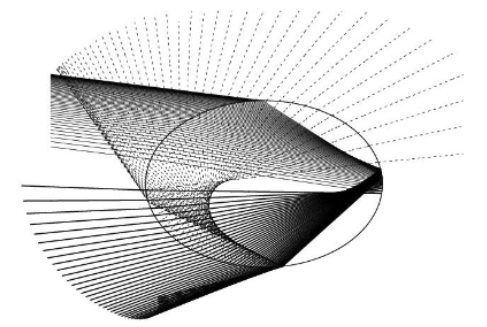
We approach the study of the rainbow with two primary objectives: 1) to analyze the explicit dependence of the intensity and angular position of the first-order rainbow on different parameters, critically, water temperature; 2) to compare the results of geometric optics with those derived from wave theory. To achieve this, we implemented a discretization method to circumvent the obstacle posed by geometric optics, where the cross-section, and thus light intensity, diverges at the minimum deviation angle. Wave phenomena were incorporated using the Airy approximation. Through calculations spanning a broad range of parameter values, we derived analytical expressions that efficiently compute both the light intensity at the first-order rainbow’s peak and its angular position, as functions of light wavelength, drop radius, and water temperature.
Downloads
References
C. A. Paola, A. Cruzado, and F. M. Carrasco Galleguillos, Light refraction in the earth’s atmosphere I. Inferior mirages: analytic solution of ray paths, Rev. Mex. Fis. 68 4 (2022) 041301 1. https://doi.org/10.31349/RevMexFis.68.041301 DOI: https://doi.org/10.31349/RevMexFis.68.041301
A. Cruzado, A. Cesanelli and C. A. Paola, Light refraction in the earth’s atmosphere II. Inferior mirages: regions for images and objects observation, Rev. Mex. Fis. 69 6 (2023) 061303 1. https://doi.org/10.31349/RevMexFis.69.061303 DOI: https://doi.org/10.31349/RevMexFis.69.061303
C. A. Paola, A. Cruzado and A. Cesanelli, Light refraction in the earth’s atmosphere III. Inferior mirages: images locus, Rev. Mex. Fis. 70 3 (2024) 031301 1. https://doi.org/10.31349/RevMexFis.70.031301 DOI: https://doi.org/10.31349/RevMexFis.70.031301
T. Young, The Bakerian Lecture. Experiments and calculations relative to physical optics, Phil. Trans. R. Soc. 94 (1804) 1. https://doi.org/10.1098/rstl.1804.0001 DOI: https://doi.org/10.1098/rstl.1804.0001
G. B. Airy, On the intensity of light in the neighbourhood of a caustic, Trans. Cambridge Philos. Soc. 6 (1838) 379. ID: 209973084
G. Mie, Beiträge zur Optik trüber Medien, speziell kolloidaler Metallosungen, Ann. Phys. 330 3 (1908) 377. https://doi.org/10.1002/andp.19083300302 DOI: https://doi.org/10.1002/andp.19083300302
H. M. Nussenzveig, High Frequency Scattering by a Transparent Sphere. II. Theory of the Rainbow and the Glory, J. Math. Phys. 10 (1969) 125. https://doi.org/10.1063/1.1664747 DOI: https://doi.org/10.1063/1.1664747
H.M. Nussenzveig, The theory of the rainbow, Scientific American, 236 (1977) 116. https://doi.org/10.1038/scientificamerican0477-116 DOI: https://doi.org/10.1038/scientificamerican0477-116
H.M. Nussenzveig, Diffraction Effects in Semiclassical Scattering (University Press, Cambridge, 1992) pp 101-116. https://doi.org/10.1017/CBO9780511599903 DOI: https://doi.org/10.1017/CBO9780511599903
J. D. Walker, Multiple rainbows from single drops of water and other liquids, Am. J. Phys. 44 (1976) 421. https://doi.org/10.1119/1.10172 DOI: https://doi.org/10.1119/1.10172
S. D. Mobbs, Theory of the Rainbow, J. Opt. Soc. Am. 69 (1979) 1089. https://doi.org/10.1364/JOSA.69.001089 DOI: https://doi.org/10.1364/JOSA.69.001089
G. Casini, A. Covello, The rainbow in the drop, Am. J. Phys. 80 11 (2012) 1027. https://doi.org/10.1119/1.4732530 DOI: https://doi.org/10.1119/1.4732530
R. A. R. Tricker, Introduction to meteorological optics (American Elsevier Pub. Co., 1970) pp. 42-69, pp. 169-190, pp. 210- 229
R. Greenler, Rainbows, halos and glories (Society of PhotoOptical Instrumentation Engineers, Bellingham, Washington USA, 2020). https://doi.org/10.1117/3.2573017 DOI: https://doi.org/10.1117/3.2573017.ch1
M. G. J. Minnaert, Light and colours in the outdoors (Springer New York, NY., 1993) pp 185-258. https://doi.org/10.1007/978-1-4612-2722-9 DOI: https://doi.org/10.1007/978-1-4612-2722-9_10
N. Roth, K. Anders, and A. Frohn, Simultaneous measurement of temperature and size of droplets in the micrometer range, J. Laser Appl. 2 (1990) 37. https://doi.org/10.2351/1.4745251 DOI: https://doi.org/10.2351/1.4745251
N. Roth, K. Anders, and A. Frohn, Refractive-index measurements for the correction of particle sizing methods Appl. Opt. 30 (1991) 4960. https://doi.org/10.1364/AO.30.004960 DOI: https://doi.org/10.1364/AO.30.004960
J. P. A. J. Van Beeck and M. L. Riethmuller, M. L., Simultaneous determination of temperature and size of droplets from the rainbow using Airy theory. Developments in Laser Techniques and Applications to Fluid Mechanics: Proceedings of the 7th International Symposium Lisbon, Portugal, 11-14 July, 1994 (Berlin, Heidelberg: Springer Berlin Heidelberg, 1996) pp. 330-339 DOI: https://doi.org/10.1007/978-3-642-79965-5_22
J. P. A. J. Van Beeck, Rainbow phenomena: development of a laser-based, non-intrusive technique for measuring droplet size, temperature and velocity. [Phd Thesis 2 (Research NOT TU/e / Graduation TU/e), Applied Physics and Science Education]. Technische Universiteit Eindhoven, The Netherlands (1997). https://doi.org/10.6100/IR493789
S. Saengkaew, Development of novel global rainbow technique for characterizing spray generated by ultrasonic nozzle. Chulalongkorn University Theses and Dissertations (Chula ETD). 65622 (2005). https://digital.car.chula.ac.th/chulaetd/65622
Chanisa Kanjanasakul, Analysis of the optical properties of droplets of different fluids in high-pressure environments by rainbow optical diagnostic. Physics [physics]. Normandie Université (2017). https://theses.hal.science/tel-01791028v1/file/CK.pdf
Lv. Qimeng, Wu. Yingchun, and Wu. Xuecheng, Surface temperature measurement of cooling and heating droplets by rainbow refractometry, Appl. Opt. 61 (2022) 7455. https://doi.org/10.1364/AO.470123 DOI: https://doi.org/10.1364/AO.470123
A. N. Bashkatov, E. A. Genina, Water refractive index in dependence on temperature and wavelength: a simple approximation, Proc. SPIE 5068 (2003) 393. https://doi.org/10.1117/12.518857 DOI: https://doi.org/10.1117/12.518857
E. Kendir, S. Yaltkaya, Effect of temperature and wavelength on the refractive index of water: a fiber-optic sensor application, Indian J. Phys. 96 (2022) 1247. https://doi.org/10.1007/s12648-021-02064-7 DOI: https://doi.org/10.1007/s12648-021-02064-7
R. L. Lee Jr., Mie theory, Airy theory, and the natural rainbow, Appl. Opt. 37 (1998) 1506. https://doi.org/10.1364/AO.37.001506 DOI: https://doi.org/10.1364/AO.37.001506
P. Laven, Simulation of rainbows, coronas, and glories by use of Mie theory, Appl. Opt. 42 (2003) 436. https://doi.org/10.1364/AO.42.000436 DOI: https://doi.org/10.1364/AO.42.000436
F. W. J. Olver, Airy and Related Functions, National Institute of Standards and Technology (NITS), Digital Library of Mathematical Functions, Chapter 9 (2010). https://dlmf.nist.gov/9.4
F. W. J. Olver, Airy and Related Functions, National Institute of Standards and Technology (NITS), Digital Library of Mathematical Functions, Chapter 9 (2010). https://dlmf.nist.gov/9.7.E9
M.V. Berry and S. Klein, Diffraction near fake caustics, Eur. J. Phys. 18 (1997) 303. https://dx.doi.org/10.1088/0143-0807/18/4/011 DOI: https://doi.org/10.1088/0143-0807/18/4/011
M. V. Berry, Nature’s optics and our understanding of light, Contemp. Phys. 56 (2015) 2. https://dx.doi.org/10.1080/00107514.2015.971625 DOI: https://doi.org/10.1080/00107514.2015.971625
J. A. Adam, The mathematical physics of rainbows and glories, Phys. Rep. 356 (2002) 229. https://doi.org/10.1016/S0370-1573(01)00076-X DOI: https://doi.org/10.1016/S0370-1573(01)00076-X
J.D. Jackson, From Alexander of Aphrodisias to Young and Airy, Phys. Rep. 320 (1999) 27. https://doi.org/10.1016/S0370-1573(99)00088-5 DOI: https://doi.org/10.1016/S0370-1573(99)00088-5
I. Thormählen, J. Straub, and U. Grigull, Refractive Index of Water and Its Dependence on Wavelength, Temperature, and Density, J. Phys. Chem. Ref. Data 14 (1985) 933. https://doi.org/10.1063/1.555743 DOI: https://doi.org/10.1063/1.555743
R. Gosnell, C. W. Fairall, and P. J. Webster. The sensible heat of rainfall in the tropical ocean. Journal of Geophysical Research: Oceans 100 C9 18437-18442. https://doi.org/10.1029/95JC01833 DOI: https://doi.org/10.1029/95JC01833
C. Raymond, T. Matthews, and R. M. Horton, The emergence of heat and humidity too severe for human tolerance, Science Advance 6 (2020) 1. https://doi.org/10.1126/sciadv.aaw1838 DOI: https://doi.org/10.1126/sciadv.aaw1838
S. P. Anderson, A. Hinton, and R. A. Weller, Moored observations of precipitation temperature, Journal of Atmospheric and Oceanic Technology 15 (1998) 979. https://doi.org/10.1175/1520-0426(1998)015h0979:MOOPTi2.0.CO;2 DOI: https://doi.org/10.1175/1520-0426(1998)015<0979:MOOPT>2.0.CO;2
J. Master. Hottest rain on record? Rain falls at 109◦ F in Saudi Arabia, Wunderground Category 6 (2012). https://www.wunderground.com/blog/JeffMasters/hottest-rain-on-record-rain-falls-at-109f -in-saudi-arabia.html
Downloads
Published
How to Cite
Issue
Section
License
Copyright (c) 2026 A. Cruzado, A. Cesanelli, C. A. Paola

This work is licensed under a Creative Commons Attribution-NonCommercial-NoDerivatives 4.0 International License.
Authors retain copyright and grant the Revista Mexicana de Física right of first publication with the work simultaneously licensed under a CC BY-NC-ND 4.0 that allows others to share the work with an acknowledgement of the work's authorship and initial publication in this journal.