
Embedded gallium oxide-silica composites in silica matrix via sol-gel process
DOI:
https://doi.org/10.31349/RevMexFis.72.041008Keywords:
Electrostatic force microscope; gallium oxide; silica composites; sol-gel; tetraethyl orthosilicateAbstract
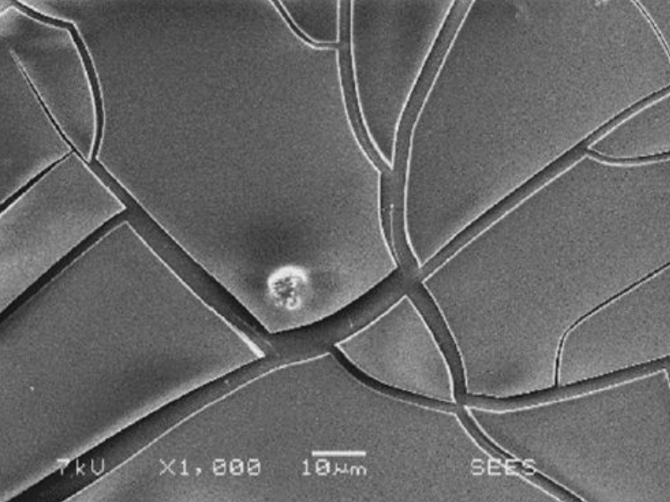
This work reports the synthesis of a gallium oxide (Ga2O3)–silica composite within a silica matrix via a modified sol-gel process, with the novelty residing in the incorporation of Ga2O3 during the condensation stage. In conventional sol-gel synthesis of silica matrices or nanoparticles, ethanol and tetraethyl orthosilicate (TEOS) are mixed prior to hydrolysis, followed by a distinct condensation step. Typically, the incorporation of a second material into a silica matrix, such as micro-or nanoparticles, is carried out in a separate step using techniques like spray pyrolysis, chemical vapor deposition (CVD), or sputtering. In contrast, the present approach enables the formation of a Ga2O3–silica composite during the condensation step, thereby eliminating the need for post-synthesis deposition methods. This is achieved by introducing a Ga2O3 suspension into the TEOS solution prior to hydrolysis. Samples were fabricated by dropcasting both standard and modified sols onto glass substrates, with each layer formed by three successive drops. The functionalization and structural characteristics of the resulting materials were analyzed using X-ray diffraction (XRD), micro-Raman spectroscopy, scanning electron microscopy (SEM), and electrostatic force microscopy (EFM). These characterization techniques confirmed the successful integration of Ga2O3 within the silica matrix. In particular, EFM measurements distinguished between silica and Ga2O3 domains based on surface charge amplitude. The results demonstrate that both the Ga2O3 concentration in the colloidal suspension and the number of deposited layers significantly influence the crystalline structure and morphology of the silica matrix. This simple modification to the sol-gel method is proposed as a general and scalable strategy for the synthesis of metal oxide–silica composites and the functionalization of silica-based materials.
Downloads
References
A. A. Nayl et al., Recent progress in the applications of silicabased nanoparticles, RSC Adv., 12 (2022) 13706, https://doi.org/10.1039/D2RA01587K DOI: https://doi.org/10.1039/D2RA01587K
L. Mathey et al., Functionalization of silica nanoparticles and native silicon oxide with tailored boron-molecular precursors for efficient and predictive p-doping of silicon, J. Phys. Chem. C, 119 (2015) 13750, https://doi.org/10.1021/acs.jpcc.5b03408 DOI: https://doi.org/10.1021/acs.jpcc.5b03408
D. K. Sharma et al., Super-Hydrophobic Nanostructured Silica Coating on Aluminum Substrate for Moist Air Condensation. J. Mat. Eng. Perform., 31 (2022) 1266, https://doi.org/10.1007/s11665-021-06254-6 DOI: https://doi.org/10.1007/s11665-021-06254-6
K. Koseki et al., RAFT polymerization,polymer electrolyte fuel cell,proton conductivity,silica nanoparticle,surface silanol group, ACS Sustain. Chem. Eng. 9 (2021) 10093, https://doi/abs/10.1021/acssuschemeng.1c01922 DOI: https://doi.org/10.1021/acssuschemeng.1c01922
X. Jiang et al., Synthesis and formation mechanism of amorphous silica particles via sol-gel process with tetraethylorthosilicate, Ceram. Int., 45 (2019) 7673, https://doi/10.1016/j.ceramint.2019.01.067 DOI: https://doi.org/10.1016/j.ceramint.2019.01.067
A. Alshahrie, A.A. Al-Ghamdi, and W. Alsayed, The optical and luminescence properties of Zn1−xGdxO (0 ≤ x ≤ 0.07) quantum dots synthesized via tetraethyl orthosilicate assisted colloidal regime for laser diodes application potential, Optik, 206 (2020) 163748, https://doi/10.1016/j.ijleo.2019.163748 DOI: https://doi.org/10.1016/j.ijleo.2019.163748
G. A. Molina et al., Effects of tetraethyl orthosilicate (TEOS) on the light and temperature stability of a pigment from beta vulgaris and its potential food industry applications, Molecules, 19 (2014) 17985, https://doi/10.3390/molecules191117985 DOI: https://doi.org/10.3390/molecules191117985
W. Liu et al., Dye-sensitized solar cells,Synthesis,TEOSassisted,Ultra-small sheets, Appl. Surf. Sci., 313 (2014) 498, https://doi/10.1016/J.APSUSC.2014.06.011 DOI: https://doi.org/10.1016/j.apsusc.2014.06.011
J. Yan et al., Microstructure and oxidation behavior of SiOC coatings on C/C composites co-deposited with HMDS and TEOS by using CVD process, Ceram. Int., 50 (2024) 7888, https://doi/10.1016/J.CERAMINT.2023.12.117 DOI: https://doi.org/10.1016/j.ceramint.2023.12.117
W. Zheng et al., Strengthen corrosion resistance of epoxy coating by synergy of oxygen vacancies of CeO2 nanoparticles as charge capture centers and BTA/TEOS, Prog. Org. Coat., 192 (2024) 108481, https://doi/10.1016/J.PORGCOAT.2024.108481 DOI: https://doi.org/10.1016/j.porgcoat.2024.108481
Rimpy, and M. Ahuja, Mechanical properties, Fluconazoleloaded TEOS-modified nanocellulose 3D scaffolds - Fabrication, characterization and its application as vaginal drug delivery system, J. Drug Deliv. Sci. Technol., 75 (2022) 103646, https://doi/10.1016/J.JDDST.2022.103646 DOI: https://doi.org/10.1016/j.jddst.2022.103646
M. S. Mulla, A. I. Torvi, L. C. Poulose, and M. Y. Kariduraganavar, Development of novel PVA-TEOS-MnO2 and its PANI incorporated flexible membrane electrodes and evaluation of their supercapacitor performance, Electrochim. Acta, 470 (2023) 143260, https://doi/10.1016/J.ELECTACTA.2023.143260 DOI: https://doi.org/10.1016/j.electacta.2023.143260
R. Ciriminna et al., The sol-gel route to advanced silica-based materials and recent applications, Chem. Rev., 113 (2013) 6592, https://doi/10.1021/cr300399c DOI: https://doi.org/10.1021/cr300399c
O. Malay, I. Yilgor, and Y. Z. Menceloglu, Effects of solvent on TEOS hydrolysis kinetics and silica particle size under basic conditions, J. Sol-Gel Sci. Technol., 67 (2013) 351, https://doi/10.1007/s10971-013-3088-4 DOI: https://doi.org/10.1007/s10971-013-3088-4
A. Oprea, N. Bârsan, and U. Weimar, Work function changes in gas sensitive materials: Fundamentals and applications, Sens. Actuators, B, 142 (2009) 470, https://doi/10.1016/j.snb.2009.06.043 DOI: https://doi.org/10.1016/j.snb.2009.06.043
A. Devamanoharan et al., Investigating Stable Low-Energy Gallium Oxide (Ga2O3) Polytypes: Insights into Electronic and Optical Properties from First Principles, ACS Omega, 9 2024 16207, https://doi/10.1021/acsomega.3c10192 DOI: https://doi.org/10.1021/acsomega.3c10192
X. Liu et al., Gallium oxide nanorods by the conversion of gallium oxide hydroxide nanorods, J. Alloys. Compd., 439 (2007) 275, https://doi/10.1016/J.JALLCOM.2006.08.062 DOI: https://doi.org/10.1016/j.jallcom.2006.08.062
J. Debdeep, Gallium Oxide Materials Properties, Crystal Growth, and Devices, 1st edition. (Springer, Cham, 2020), pp. 739-754 https://doi.org/10.1007/978-3-030-37153-1 DOI: https://doi.org/10.1007/978-3-030-37153-1_40
K. Sato et al., High-temperature operation of gallium oxide memristors up to 600 K, Scientific Reports, 13 (2023) 1261, https://doi/10.1038/s41598-023-28075-4 DOI: https://doi.org/10.1038/s41598-023-28075-4
J. Zhu et al., Gallium Oxide for Gas Sensor Applications: A Comprehensive Review, Materials, 15 (2022) 7339, https://doi.org/10.3390/ma15207339Academic DOI: https://doi.org/10.3390/ma15207339
L. Wang et al., Recent Progress in Solar-Blind Photodetectors Based on Ultrawide Bandgap Semiconductors, ACS Omega, 9 (2024) 25429, https://doi/10.1021/acsomega.4c02897 DOI: https://doi.org/10.1021/acsomega.4c02897
W. Lueangchaichaweng et al., Gallium oxide nanorods: novel, template-free synthesis and high catalytic activity in epoxidation reactions, Angew. Chem. Int. Ed., 53 (2014) 1585, https://doi/10.1002/ange.201308384 DOI: https://doi.org/10.1002/anie.201308384
A. J. Green et al., β-Gallium oxide power electronics, APL Materials, 10 (2022) 029201, https://doi/10.1063/5.0060327
R. A. El-Salamony, and R. E. Morsi, Stable gallium oxide@ silica/polyvinyl pyrrolidone hybrid nanofluids: Preparation, characterization, and photo-activity toward removal of malachite green dye, J. Mol. Liq., 271 (2018) 589, https://doi/10.1016/j.molliq.2018.08.139 DOI: https://doi.org/10.1016/j.molliq.2018.08.139
I. Takahara et al., Effects of pre-treatment of a silicasupported gallium oxide catalyst with H2 on its catalytic performance for dehydrogenation of propane, Catal. Lett., 96 (2004) 29, https://doi/10.1023/B:CATL.0000029525.33197.89 DOI: https://doi.org/10.1023/B:CATL.0000029525.33197.89
L. Yuliati et al., Photocatalytic nonoxidative coupling of methane on gallium oxide and silica-supported gallium oxide, J. Catal., 257 (2008) 396, https://doi/10.1016/j.jcat.2008.05.022 DOI: https://doi.org/10.1016/j.jcat.2008.05.022
C. A. M. Mulder, and A. A. J. M. Damen, The origin of the “defect” 490 cm−1 Raman peak in silica gel, J. NonCryst. Solids, 93 (1987) 387, https://doi/10.1016/S0022-3093(87)80183-7 DOI: https://doi.org/10.1016/S0022-3093(87)80183-7
S. B. Khemis et al., Structural analysis of sputtered amorphous silica thin films: A Raman spectroscopy investigation, Thin Solid Films, 733 (2021) 138811, https://doi/10.1016/j.tsf.2021.138811 DOI: https://doi.org/10.1016/j.tsf.2021.138811
D. Manara, A. Grandjean, and D. R. Neuville, Advances in understanding the structure of borosilicate glasses: A Raman spectroscopy study, Am. Mineral., 94 (2009) 777, https://doi/10.2138/am.2009.3027 DOI: https://doi.org/10.2138/am.2009.3027
O. N. Koroleva, L. A. Shabunina, and V. N. Bykov, Structure of borosilicate glass according to Raman spectroscopy data, Glass and Ceramics, 67 (2011) 340, https://doi/10.1007/s10717-011-9293-0 DOI: https://doi.org/10.1007/s10717-011-9293-0
B. Liu, M. Gu, and X. Liu, Lattice dynamical, dielectric, and thermodynamic properties of β-Ga2O3 from first principles, Appl. Phys. Lett., 91 (2007) 3, https://doi/10.1063/1.2800792 DOI: https://doi.org/10.1063/1.2800792
Y. Zhao, and R. L. Frost, Raman spectroscopy and characterisation of α-gallium oxyhydroxide and β-gallium oxide nanorods, J. Raman Spectrosc., 39 (2008) 1494, https://doi/10.1002/jrs.2028 DOI: https://doi.org/10.1002/jrs.2028
M. Barisik et al., Size dependent surface charge properties of silica nanoparticles, J. Phys. Chem. C, 118 (2014) 1836, https://doi/10.1021/jp410536n DOI: https://doi.org/10.1021/jp410536n
B. O. Alan, M. Barisik, and H. G. Ozcelik, Roughness Effects on the Surface Charge Properties of Silica Nanoparticles, J. Phys. Chem. C, 124 (2020) 19327455, https://doi/10.1021/acs.jpcc.0c00120 DOI: https://doi.org/10.1021/acs.jpcc.0c00120
A. Y. Polyakov et al., Impact of Hydrogen Plasma on Electrical Properties and Deep Trap Spectra in Ga2O3 Polymorphs, Crystals, 13 (2023) 1400, https://doi/10.3390/CRYST13091400 DOI: https://doi.org/10.3390/cryst13091400
F. Shi, and H. Qiao, Preparations, properties and applications of gallium oxide nanomaterials - A review, Nano Select, 3 (2022) 348, https://doi/10.1002/nano.202100149 DOI: https://doi.org/10.1002/nano.202100149
J. E. N. Swallow et al., Transition from electron accumulation to depletion at β-Ga2O3 surfaces: The role of hydrogen and the charge neutrality level, APL Materials, 7 (2019) 022528, https://doi/10.1063/1.5054091 DOI: https://doi.org/10.1063/1.5054091
Downloads
Published
How to Cite
Issue
Section
License
Copyright (c) 2026 F. Ramírez-González, R. A. Vázquez-Sánchez, R. Herrera-Rivera, J. Conde, H. Vilchis Bravo

This work is licensed under a Creative Commons Attribution-NonCommercial-NoDerivatives 4.0 International License.
Authors retain copyright and grant the Revista Mexicana de Física right of first publication with the work simultaneously licensed under a CC BY-NC-ND 4.0 that allows others to share the work with an acknowledgement of the work's authorship and initial publication in this journal.