
Experimental observation of frequency of oscillation, amplitude and temporal symmetry of a Clapp oscillator incorporating a physical memristor
DOI:
https://doi.org/10.31349/RevMexFis.72.050901Keywords:
Knowm Memristor, Clapp Oscillator, Frequency, Amplitude, SymmetryAbstract
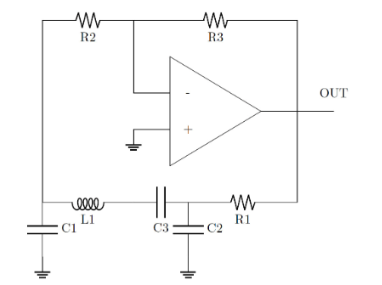
The Clapp oscillator consists of one voltage amplifier, one inductor, three capacitors, and three resistors. The proposed work analyses the Clapp oscillator when two resistors are replaced by a commercially available physical memristor, e.g. the Knowm memristor, and a third case when the polarity of the memristor is inverted. In this manner, three cases are analyzed and compared with the responses of the Clapp oscillator without a memristive element. The responses of the experiments show how the position and polarity of the Knowm memristor influence the steady-state behavior of the LC resonant oscillator. The results show that the three cases, using the Knowm memristor, produce measurable changes in frequency of oscillation, amplitude, and temporal symmetry of the output waveform, whereas reversing the memristor polarity, reverses both frequency and temporal asymmetry trends. As a conclusion, the observed behaviors indicate that the memristor acts as a dynamic and history-dependent element, i.e. it modifies the oscillation conditions of the Clapp oscillator beyond the effects of a static resistive component. These findings establish that the Clapp oscillator topology, is a suitable experimental platform for studying memristive effects in LC resonant systems. The results provide insights into the role of memristive devices position and polarity in shaping oscillatory dynamics.
Downloads
References
B. Razavi, Microelectronics, 2nd ed. (Wiley, 2015)
D. Garinto, A. Syahriar, and S. Budiyanto, A Novel Op- Amp Based LC Oscillator for Wireless Communications, In IECON 2020. The 46th Annual Conference of the IEEE Industrial Electronics Society (2020) pp. 2243-2248, https://doi.org/10.1109/IECON43393.2020.9255128 DOI: https://doi.org/10.1109/IECON43393.2020.9255128
L. O. Chua, Memristor-The Missing Circuit Element, IEEE Transactions on Circuit Theory 18 (1971) 507, https://doi.org/10.1109/TCT.1971.1083337 DOI: https://doi.org/10.1109/TCT.1971.1083337
A. Talukdar, A. G. Radwan, and K. N. Salama, Time Domain Oscillating Poles: Stability Redefined in Memristor- Based Wien Oscillators, In Proceedings of the 2010 International Conference on Microelectronics, (Cairo, Egypt2010) pp. 288-291, https://doi.org/10.1109/ICM.2010.5696704 DOI: https://doi.org/10.1109/ICM.2010.5696140
A. Talukdar, A. G. Radwan, and K. N. Salama, Generalized Model for Memristor-Based Wien Family Oscillators, Microelectronics Journal 42 (2011) 1032, https://doi.org/10.1016/j.mejo.2011.06.001 DOI: https://doi.org/10.1016/j.mejo.2011.07.001
A. Karthikeyan et al., A Simple Chaotic Wien Bridge Oscillator with a Fractional-Order Memristor and Its Combination Synchronization for Efficient Antiattack Capability, Complexity 2021 (2021), https://doi.org/10.1155/2021/8857075 DOI: https://doi.org/10.1155/2021/8857075
V. Rakitin, S. Rusakov, and S. Ulyanov, The Coupled Reactance-Less Memristor-Based Relaxation Oscillators for Binary Oscillator Networks, Micromachines 14 (2023) 365, https://doi.org/10.3390/mi14020365 DOI: https://doi.org/10.3390/mi14020365
R. Dutta, A. Karmakar, and S. Kundu, A Review on MemristorBased Reactance-Less Relaxation Oscillator, In Lecture Notes in Electrical Engineering, vol. 1046 (Springer, 2023), https://doi.org/10.1007/978-981-99-1695-3_44 DOI: https://doi.org/10.1007/978-981-99-2710-4_13
L. M. Lopez-Jimenez et al., Experimental Evaluation of Memristor-Enhanced Analog Oscillators: Relaxation and Wien-Bridge Cases, Dynamics 5 (2025) 43, https://doi.org/10.3390/dynamics5040043 DOI: https://doi.org/10.3390/dynamics5040043
F. Setoudeh and M. M. Dezhdar, An Overview of Sinusoidal Oscillators Based on Memristive Devices, In IntechOpen (IntechOpen, 2024), https://doi.org/10.5772/intechopen.113403 DOI: https://doi.org/10.5772/intechopen.111807
E. Solovyeva, A. Serdyuk, and Y. Inshakov, Tunable Active Wien Filters Based on Memristors, Micromachines 16 (2025) 769, https://doi.org/10.3390/mi16070769 DOI: https://doi.org/10.3390/mi16070769
A. Nugent, Knowm Memristor Discovery Manual (Knowm Inc., 2020)
J. Petrzela, Chaotic and Hyperchaotic Dynamics of a Clapp Oscillator, Mathematics 10 (2022), https://doi.org/10.3390/math10111868 DOI: https://doi.org/10.3390/math10111868
Downloads
Published
How to Cite
Issue
Section
License
Copyright (c) 2026 T. A. Jimenez Castillo, L. M. Lopez Jimenez, E. Tlelo-Cuautle, A. Diaz Sanchez

This work is licensed under a Creative Commons Attribution-NonCommercial-NoDerivatives 4.0 International License.
Authors retain copyright and grant the Revista Mexicana de Física right of first publication with the work simultaneously licensed under a CC BY-NC-ND 4.0 that allows others to share the work with an acknowledgement of the work's authorship and initial publication in this journal.