
Numerical modeling of spin-dependent phase shifts in nucleon-nucleon scattering
DOI:
https://doi.org/10.31349/RevMexFis.72.061202Keywords:
Phase function method, Poschl-Teller plus spin-orbit interaction, scattering phase shifts, nucleon-nucleon systemsAbstract
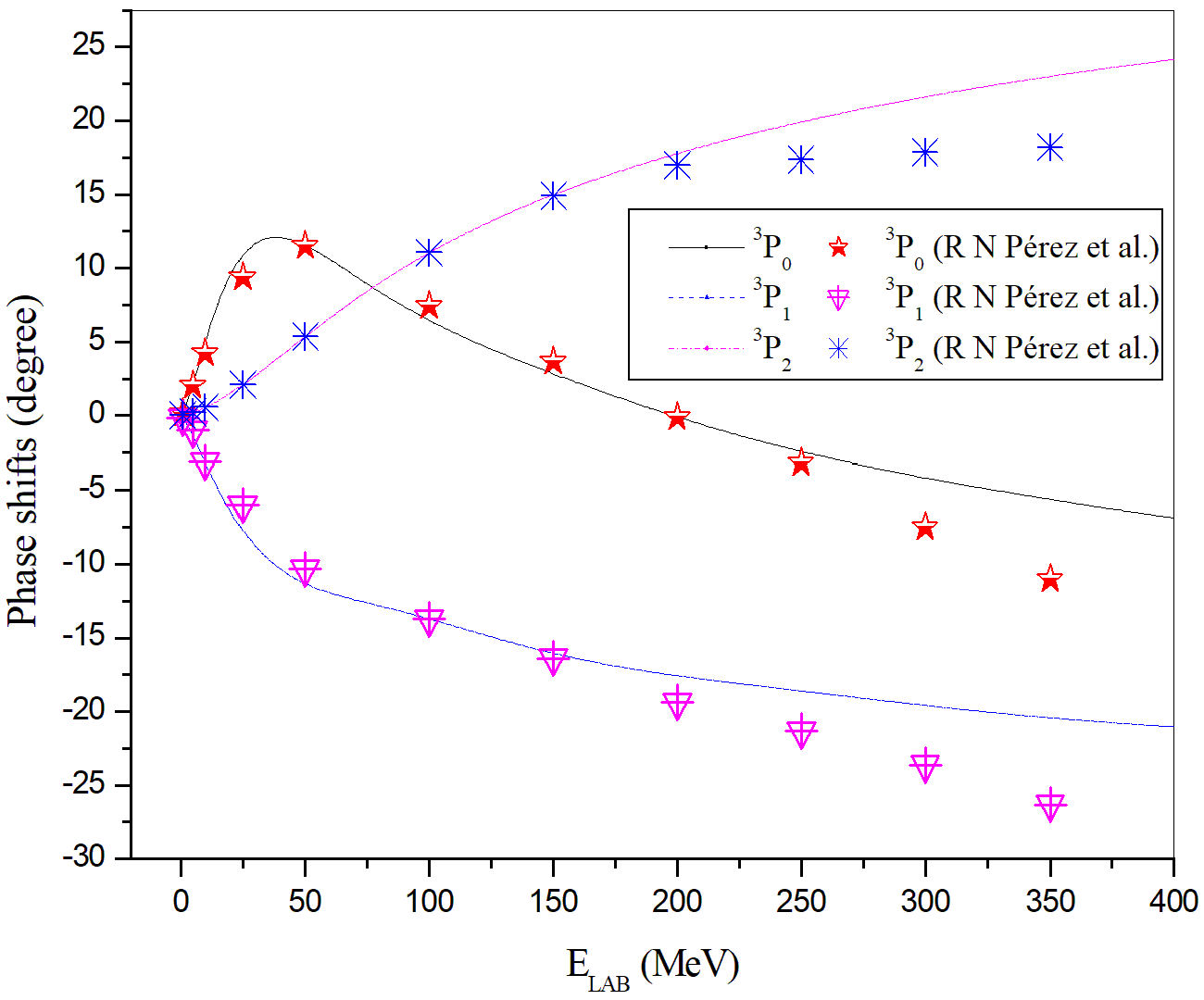
Scattering phase shifts for quantum mechanical potential scattering can be derived directly from the scattering amplitude, bypassing the need to solve the Schrödinger equation explicitly. This can be achieved by numerically integrating the phase equation from the origin to the asymptotic limit. The Phase Function Method (PFM) is considered an effective approach for computing scattering phase shifts in quantum mechanics. The Phase Function Method (PFM) is applied to analyze the Pöschl–Teller potential along with spin-orbit interactions. The strategy includes employing a five-parameter potential model to fit the calculated scattering phase shift curves to the established data for elastic scattering phase shifts. Numerical scattering phase shifts for nucleon-nucleon systems align well with prior research results.
Downloads
References
M. G. Mayer, On closed shells in nuclei, Physical Review 74 (1948) 235 DOI: https://doi.org/10.1103/PhysRev.74.235
O. Haxel, J. H. D. Jensen, and H. E. Suess, On the “Magic Numbers” in Nuclear Structure, Physical Review 75 (1949) 1766-1766 DOI: https://doi.org/10.1103/PhysRev.75.1766.2
K. Krane, Introductory Nuclear Physics (Wiley John Sons, New York, 1988)
H. Hong-Xia, et al., Influence of Spin-Orbit Force on NucleonNucleon Scattering in the Quark Delocalization Colour Screening Model, Chinese Physics Letters 25 (2008) 1617- 1620 DOI: https://doi.org/10.1088/0256-307X/25/5/026
N. Kaiser, Nuclear spin-orbit interaction from chiral pionnucleon dynamics, Nuclear Physics A 709 (2002) 251- 274 DOI: https://doi.org/10.1016/S0375-9474(02)01044-8
M. Sajedi and Z. Kargar, Shifted Deng-Fan potential and cluster structure in 19Ne, Nuclear Physics A 1015 (2021) 122314 DOI: https://doi.org/10.1016/j.nuclphysa.2021.122314
L. Kumar, A. Khachi, and O. Sastri, Phase Shift Analysis for Neutron-Alpha Elastic Scattering Using Phase Function Method with Local Gaussian Potential, Journal of Nuclear Physics, Material Sciences, Radiation and Applications 9 (2022) 215-221 DOI: https://doi.org/10.15415/jnp.2022.92032
F. Brieva and J. Rook, Nucleon-nucleus optical model potential, Nuclear Physics A 297 (1978) 206-230 DOI: https://doi.org/10.1016/0375-9474(78)90272-5
G. Poschl and E. Teller, Bemerkungen zur Quantenmechanik des anharmonischen Oszillators, Zeitschrift fur Physik 83 (1933) 143-151 DOI: https://doi.org/10.1007/BF01331132
G.-F. Wei and S.-H. Dong, The spin symmetry for deformed generalized Pöschl-Teller potential, Physics Letters A 373 (2009) 2428 DOI: https://doi.org/10.1016/j.physleta.2009.05.011
Y. You, et al., Solutions of the Second Pöschl-Teller Potential Solved by an Improved Scheme to the Centrifugal Term, FewBody Systems 54 (2013) 2125-2132 DOI: https://doi.org/10.1007/s00601-013-0725-y
S. H. Dong and J. Garcia Ravelo, Exact solutions of the Schrodinger equation with the second poschl-teller-like potential, Modern Physics Letters B 23 (2009) DOI: https://doi.org/10.1142/S0217984909018047
S. H. Dong, W. C. Qiang, and J. Garcia Ravelo, Analytical approximations to the Schrodinger equation for a second Pöschl-Teller-like potential with centrifugal term, International Journal of Modern Physics A 23 (2008) 1537 DOI: https://doi.org/10.1142/S0217751X0803944X
P. Sahoo, Evaluation of n-p and n-d Analyzing Powers Through the Jost Formalism, Brazilian Journal of Physics 54 (2023) DOI: https://doi.org/10.1007/s13538-023-01396-5
P. Sahoo and U. Laha, Phase shift and cross section analysis of nucleon-nucleon and nucleon-nucleus scattering using second Pöschl-Teller potential, Canadian Journal of Physics 101 (2023) 441-452 DOI: https://doi.org/10.1139/cjp-2022-0317
L. D. Faddeev, Scattering Theory for a Three-Particle System, Sov. Phys. JETP 12 (1961) 1014
E. Alt, P. Grassberger, and W. Sandhas, Reduction of the three-particle collision problem to multi-channel twoparticle Lippmann-Schwinger equations, Nuclear Physics B 2 (1967) 167-180 DOI: https://doi.org/10.1016/0550-3213(67)90016-8
K. Sekiguchi, et al., Resolving the Discrepancy of 135 MeV P-D Elastic Scattering Cross Sections and Relativistic Effects, Physical Review Letters 95 (2005) DOI: https://doi.org/10.1103/PhysRevLett.95.162301
E. Stephan, et al., Vector and tensor analyzing powers in deuteron-proton breakup at 130 MeV, Physical Review C 82 (2010) DOI: https://doi.org/10.1103/PhysRevC.82.014003
S. Kistryn, et al., Evidence of three-nucleon force effects from 130mev deuteron-proton breakup cross section measurement, Physical Review C 68 (2003) DOI: https://doi.org/10.1103/PhysRevC.68.054004
S. Ishikawa, Low-Energy Proton-Deuteron Scattering with a Coulomb-Modified Faddeev Equation, Few-Body Systems -1 (2003) 1-1 DOI: https://doi.org/10.1007/s00601-003-0001-7
A. Deltuva, A. C. Fonseca, and P. U. Sauer, Momentumspace treatment of the Coulomb interaction in three-nucleon reactions with two protons, Physical Review C 71 (2005) DOI: https://doi.org/10.1103/PhysRevC.71.054005
A. Deltuva, et al., Benchmark calculation for proton-deuteron elastic scattering observables including the Coulomb interaction, Physical Review C 71 (2005) DOI: https://doi.org/10.1103/PhysRevC.71.064003
P. Sahoo, U. Laha, and A. K. Behera, p-C12 and pd Scattering within the Separable Model of Interaction, Physics of Atomic Nuclei 83 (2020) 802-810 DOI: https://doi.org/10.1134/S1063778820660072
P. Sahoo, U. Laha, and B. Khirali, On the p-d and po16 elastic scattering, Pramana 95 (2021) DOI: https://doi.org/10.1007/s12043-021-02188-9
B. Swain, et al., Phase function method for Hulthéndistorted separable non-local potentials in all partial waves, Pramana 96 (2022) DOI: https://doi.org/10.1007/s12043-022-02410-2
B. Swain, U. Laha, and A. K. Behera, Low and intermediate energy cross section analysis of p-p and p-d elastic scattering using modified phase amplitude method for electromagnetic distorted nuclear interaction, Physica Scripta 98 (2023) 105308 DOI: https://doi.org/10.1088/1402-4896/acfb47
E. Epelbaum, H. Krebs, and P. Reinert, High-precision nuclear forces from chiral EFT: State-of-the-art, challenges, and outlook, Frontiers in Physics 8 (2020) 98 DOI: https://doi.org/10.3389/fphy.2020.00098
R. G. Newton, Scattering theory of waves and particles., 2nd ed. (Springer Verlag, New York, NY, 1982) DOI: https://doi.org/10.1007/978-3-642-88128-2
F. Calogero, Variable Phase Approach to Potential Scattering by F Calogero, Mathematics in Science and Engineering (Elsevier Science, 1967)
D. Agboola, Solutions to the modified Pöschl-Teller potential in D-dimensions, Chinese Physics Letters 27 (2010) 040301 DOI: https://doi.org/10.1088/0256-307X/27/4/040301
M. Hamzavi and A. Rajabi, Exact S-wave solution of the trigonometric poschl-teller potential, ¨ International Journal of Quantum Chemistry 112 (2012) 1592 DOI: https://doi.org/10.1002/qua.23166
S. H. Dong and A. Gonzalez Cisneros, Energy spectra of the hyperbolic and second Pöschl-Teller like potentials solved by new exact quantization rule, Annals of Physics 323 (2008) 1136 DOI: https://doi.org/10.1016/j.aop.2007.12.002
L. Infeld and T. E. Hull, The Factorization Method, Reviews of Modern Physics 23 (1951) 21-68 DOI: https://doi.org/10.1103/RevModPhys.23.21
M. Aktas and R. Sever, Exact supersymmetric solution of Schrödinger equation for central confining potentials by using the Nikiforov-Uvarov method, Journal of Molecular Structure: Theochem 710 (2004) 223 DOI: https://doi.org/10.1016/j.theochem.2004.09.011
J. I. Diaz, et al., The supersymmetric modified Pöschl-Teller and delta well potentials, Journal of Physics A: Mathematical and General 32 (1999) 8447-8460 DOI: https://doi.org/10.1088/0305-4470/32/48/308
B. Khirali, et al., Phase function metod for elastic nucleonnucleon scattering using Hellmann plus Coulomb potential, Rev. Mex. Fis. 69 (2023) DOI: https://doi.org/10.31349/RevMexFis.69.061201
B. Khirali, et al., Numerical phase shift analysis of nucleonnucleon systems with Hellmann plus spin dependence, Rev. Mex. Fis. 71 (2025) DOI: https://doi.org/10.31349/RevMexFis.71.031202
P. Sahoo, et al., Nuclear Hulthen potentials for F and G Partial waves Research & Reviews, Research Reviews: J. Phys 10 (2021) 31
A. K. Behera, et al., Study of nucleon-nucleon and alphanucleon elastic scattering by the Manning-Rosen potential, Communications in Theoretical Physics 72 (2020) 075301 DOI: https://doi.org/10.1088/1572-9494/ab8a1a
G. N. Watson, A treatise on the theory of Bessel functions, vol. 3 (The University Press, 1922)
P. SAHOO, et al., THE ANALYTIC T-MATRIX FOR THE HULTHEN POTENTIAL IN ALL PARTIAL WAVES, Reports on Mathematical Physics 88 (2021) 295-311 DOI: https://doi.org/10.1016/S0034-4877(21)00082-3
P. Sahoo, U. Laha, and B. Khirali, Hulthen off-shell transition matrix for nuclear systems, Chinese Journal of Physics 73 (2021) 561-568 DOI: https://doi.org/10.1016/j.cjph.2021.07.008
P. Sahoo and U. Laha, Treatment of hadronic systems involving two potentials under a new approximation scheme, Pramana 96 (2022) 15 DOI: https://doi.org/10.1007/s12043-021-02267-x
P. Sahoo and U. Laha, Exact solutions of the Schrödinger equation for Manning-Rosen plus Yamaguchi potential, Physica Scripta 96 (2021) 095302 DOI: https://doi.org/10.1088/1402-4896/ac07b8
R. N. Pérez, J. E. Amaro, and E. R. Arriola, The low-energy structure of the nucleon-nucleon interaction: statistical versus systematic uncertainties, Journal of Physics G: Nuclear and Particle Physics 43 (2016) 114001 DOI: https://doi.org/10.1088/0954-3899/43/11/114001
J. L. Friar, et al., Benchmark solutions for n-d breakup amplitudes, Physical Review C 51 (1995) 2356-2359 DOI: https://doi.org/10.1103/PhysRevC.51.2356
A. Kievsky, M. Viviani, and S. Rosati, Cross section, polarization observables, and phase-shift parameters in p-d and nd elastic scattering, Physical Review C 52 (1995) R15-R19 DOI: https://doi.org/10.1103/PhysRevC.52.R15
A. Kievsky, M. Viviani, and S. Rosati, scattering above the deuteron breakup threshold, Physical Review C 56 (1997) 2987-2991 DOI: https://doi.org/10.1103/PhysRevC.56.2987
Downloads
Published
How to Cite
Issue
Section
License
Copyright (c) 2026 P. Sahoo

This work is licensed under a Creative Commons Attribution-NonCommercial-NoDerivatives 4.0 International License.
Authors retain copyright and grant the Revista Mexicana de Física right of first publication with the work simultaneously licensed under a CC BY-NC-ND 4.0 that allows others to share the work with an acknowledgement of the work's authorship and initial publication in this journal.