
Deep learning based identification of solvents from post-desiccation patterns
DOI:
https://doi.org/10.31349/RevMexFis.72.061701Keywords:
Solvent identification, pattern recognition protocol, cracking process, desiccation, Neural Networks, deep learningAbstract
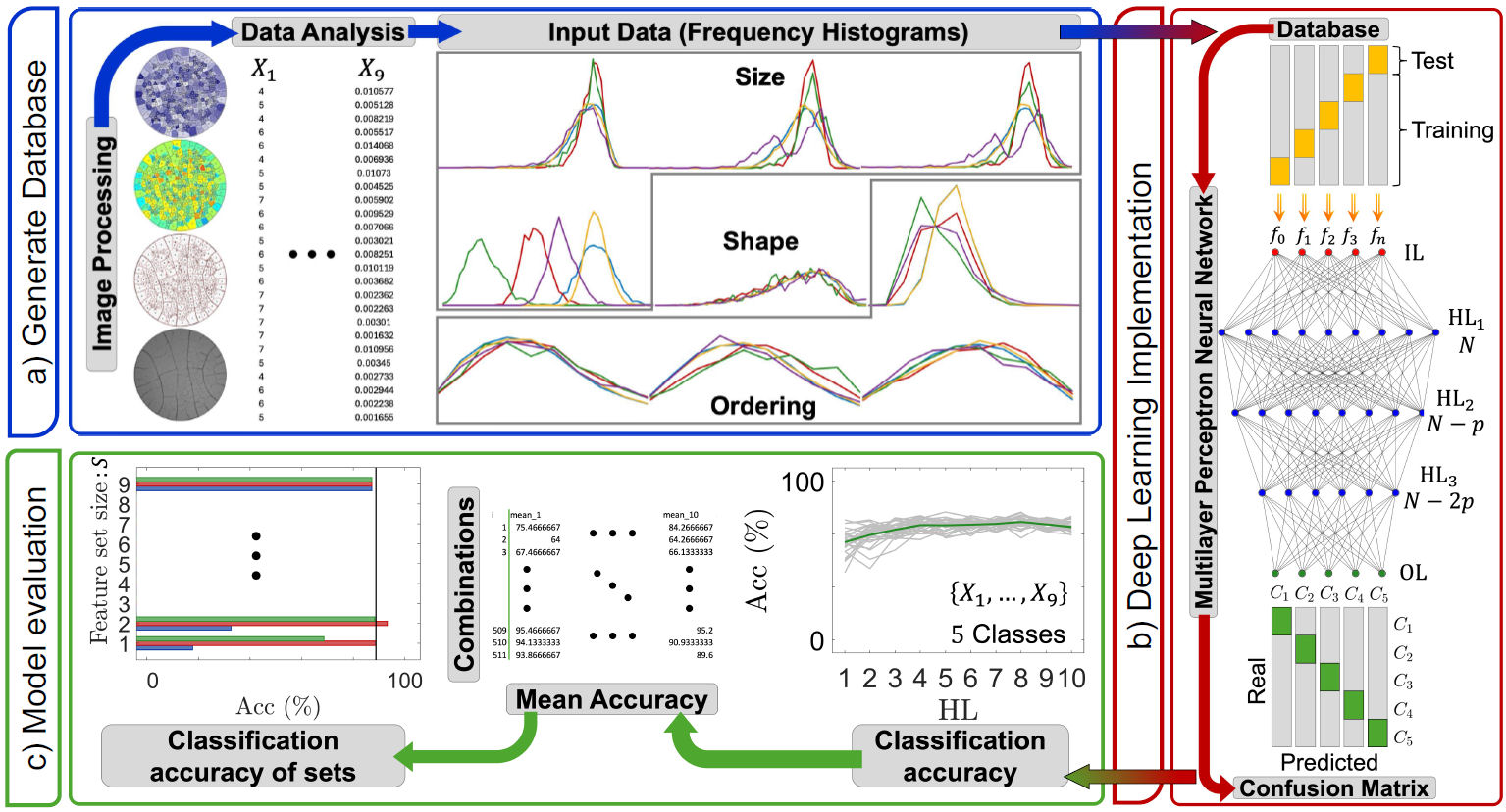
We introduce an optimized Deep learning protocol for fracture pattern classification to identify the solvent involved in the desiccation cracking process of starch-liquid slurries, even after its complete evaporation. For this purpose, image analysis techniques were used to characterize patterns obtained from drying suspensions using single solvents (water, ethanol, acetone) and two-component solvents (water-ethanol mixtures at different concentrations). Frequency histograms were generated based on nine morphological features, taking into account their size, shape, geometry and orientational ordering. Subsequently, we used these histograms as input data in different artificial neural network variants to determine which set of features leads to the highest accuracy in solvent identification. An average accuracy of up to 96(±1)% was achieved in the classification when all solvents were considered in the analysis. The highest accuracy was obtained with sets that include the crack area, AcrN , a feature barely considered in the literature. We found that AcrN can be related to the cohesive energy associated with hydrogen bond interactions. Taking this into account, we estimated some physicochemical properties of two-component solvents (specifically, the Hansen and Kamlet-Taft parameters) based solely on the features of patterns obtained from the individual components, achieving an error within 15% compared to the values determined from the literature. The proposed protocol could help to encode some implicit parameters and the optimal combination of features for pattern recognition in other fields of science and engineering.
Downloads
References
F. Moreh, et al., Deep neural networks for crack detection inside structures, Sci. Rep. 14 (2024) 4439 DOI: https://doi.org/10.1038/s41598-024-54494-y
T. Mashayekhbakhsh et al., SRU-Net: a novel spatiotemporal attention network for sclera segmentation and recognition, Pattern Anal. Applic. 27 (2024) 90 DOI: https://doi.org/10.1007/s10044-024-01301-z
J. Wang, M. Zhao, and C. Xia, An improved classification diagnosis approach for cervical images based on deep neural networks, Pattern Anal. Applic. 27 (2024) 79 DOI: https://doi.org/10.1007/s10044-024-01300-0
G. V. Ponomarev et al., ANA HEp-2 cells image classification using number, size, shape and localization of targeted cell regions, Pattern Recognit. 47 (2014) 2360 DOI: https://doi.org/10.1016/j.patcog.2013.09.027
G. V. Ponomarev and M. D. Kazanov, Classification of ANA HEp-2 slide images using morphological features of stained patterns, Pattern Recognit. Lett. 82 (2016) 79 DOI: https://doi.org/10.1016/j.patrec.2016.03.010
R. Nosaka and K. Fukui, HEp-2 cell classification using rotation invariant co-occurrence among local binary patterns, Pattern Recognit. 47 (2014) 2428 DOI: https://doi.org/10.1016/j.patcog.2013.09.018
S. Umer, B. C. Dhara, and B. Chanda, Iris recognition using multiscale morphologic features, Pattern Recognit. Lett. 65 (2015) 67 DOI: https://doi.org/10.1016/j.patrec.2015.07.008
Y. Wang et al., Learning the crystal structure genome for property classification, Phys. Rev. Res. 4 (2022) 023029 DOI: https://doi.org/10.1103/PhysRevResearch.4.023029
M. Fan, Q. Wang, and B. van der Waal, Wafer defect patterns recognition based on OPTICS and multi-label classification, In 2016 IEEE Advanced Information Management, Communicates, Electronic and Automation Control Conference (IMCEC) (2016) pp. 912-915 DOI: https://doi.org/10.1109/IMCEC.2016.7867343
J. Choi and D. Suh, A depthwise convolutional neural network model based on active contour for multi-defect wafer map pattern classification, Eng. Appl. Artif. Intell. 139 (2025) 109707 DOI: https://doi.org/10.1016/j.engappai.2024.109707
I. U. Vakarelski et al., Assembly of Gold Nanoparticles into Microwire Networks Induced by Drying Liquid Bridges, Phys. Rev. Lett. 102 (2009) 058303 DOI: https://doi.org/10.1103/PhysRevLett.102.058303
M. Ancheyta-Palacios et al., Dried Droplets of Diluted Blood to Detect a High Concentration of Lipids, Processes 11 (2023) DOI: https://doi.org/10.3390/pr11072047
J. Lasser et al., Salt Polygons and Porous Media Convection, Phys. Rev. X 13 (2023) 011025 DOI: https://doi.org/10.1103/PhysRevX.13.011025
P. Bacchin et al., Drying colloidal systems: Laboratory models for a wide range of applications, Eur. Phys. J. E 41 (2018) 1 DOI: https://doi.org/10.1140/epje/i2018-11712-x
N. Mangold, High latitude patterned grounds on Mars: Classification, distribution and climatic control, Icarus 174 (2005) 336 DOI: https://doi.org/10.1016/j.icarus.2004.07.030
X. Ma, J. Lowensohn, and J. C. Burton, Universal scaling of polygonal desiccation crack patterns, Phys. Rev. E 99 (2019) 012802 DOI: https://doi.org/10.1103/PhysRevE.99.012802
A. Montigny, D. Walwer, and C. Michaut, The origin of hierarchical cracks in floor-fractured craters on Mars and the Moon, Earth Planet. Sci. Lett. 600 (2022) 117887 DOI: https://doi.org/10.1016/j.epsl.2022.117887
W. Rapin et al., Sustained wet-dry cycling on early Mars, Nature 620 (2023) 299 DOI: https://doi.org/10.1038/s41586-023-06220-3
P. Pina et al., Polygonal terrains on Mars: A contribution to their geometric and topological characterization, Planet. Space Sci. 56 (2008) 1919 DOI: https://doi.org/10.1016/j.pss.2008.09.020
T. Choudhury and S. Costa, Prediction of Parallel Clay Cracks Using Neural Networks - A Feasibility Study, In S. Hemeda and M. Bouassida, eds., Contemporary Issues in Soil Mechanics (Springer International Publishing, Cham, 2019) pp. 214-224 DOI: https://doi.org/10.1007/978-3-030-01941-9_19
L. Goehring, Evolving fracture patterns: columnar joints, mud cracks and polygonal terrain, Phil. Trans. R. Soc. A 371 (2013) 20120353 DOI: https://doi.org/10.1098/rsta.2012.0353
T. S. K. Sasa, Pattern Selection of Cracks in Directionally Drying Fracture, Jpn. J. Appl. Phys. 36 (1997) 391 DOI: https://doi.org/10.1143/JJAP.36.391
C. Allain and L. Limat, Regular Patterns of Cracks Formed by Directional Drying of a Collodial Suspension, Phys. Rev. Lett. 74 (1995) 2981 DOI: https://doi.org/10.1103/PhysRevLett.74.2981
W. P. Lee and A. F. Routh, Why Do Drying Films Crack?, Langmuir 20 (2004) 9885 DOI: https://doi.org/10.1021/la049020v
M. D. Choudhury et al., Effect of chloride salts on desiccation cracks in bentonite, Colloid Polym. Sci. 304 (2026) 823-836 DOI: https://doi.org/10.1007/s00396-026-05570-4
L. Pauchard, B. Abou, and K. Sekimoto, Influence of Mechanical Properties of Nanoparticles on Macrocrack Formation, Langmuir 25 (2009) 6672 DOI: https://doi.org/10.1021/la9001384
C.-S. Tang et al., Desiccation and cracking behaviour of clay layer from slurry state under wetting-drying cycles, Geoderma 166 (2011) 111 DOI: https://doi.org/10.1016/j.geoderma.2011.07.018
Y. Akiba et al., Morphometric analysis of polygonal cracking patterns in desiccated starch slurries, Phys. Rev. E 96 (2017) 023003 DOI: https://doi.org/10.1103/PhysRevE.96.023003
A. Roy et al., Combinatorial topology and geometry of fracture networks, Phys. Rev. E 105 (2022) 034801 DOI: https://doi.org/10.1103/PhysRevE.105.034801
S. Bohn et al., Hierarchical crack pattern as formed by successive domain divisions. II. From disordered to deterministic behavior, Phys. Rev. E 71 (2005) 046215 DOI: https://doi.org/10.1103/PhysRevE.71.046215
S. Bohn, L. Pauchard, and Y. Couder, Hierarchical crack pattern as formed by successive domain divisions., Phys. Rev. E 71 (2005) 046214 DOI: https://doi.org/10.1103/PhysRevE.71.046214
K. F. DeCarlo and N. Shokri, Effects of substrate on cracking patterns and dynamics in desiccating clay layers, Water Resour. Res. 50 (2014) 3039 DOI: https://doi.org/10.1002/2013WR014466
J. Baer, T. Kent, and S. Anderson, Image analysis and fractal geometry to characterize soil desiccation cracks, Geoderma 154 (2009) 153 DOI: https://doi.org/10.1016/j.geoderma.2009.10.008
H.-A. Crostack et al., Analysis of crack patterns in drying corn starch by in-situ radiography and X-ray computer tomography, Exp. Mech. 52 (2012) 917 DOI: https://doi.org/10.1007/s11340-011-9581-1
L. Goehring, S.W. Morris, and Z. Lin, Experimental investigation of the scaling of columnar joints, Phys. Rev. E 74 (2006) 036115 DOI: https://doi.org/10.1103/PhysRevE.74.036115
L. Goehring, Drying and cracking mechanisms in a starch slurry, Phys. Rev. E 80 (2009) 036116 DOI: https://doi.org/10.1103/PhysRevE.80.036116
J. Liaudat and S. Muraro, Drying of silty soil treated with superabsorbent hydrogels: Retention behaviour and cracking, Eng. Geol. 331 (2024) 107433 DOI: https://doi.org/10.1016/j.enggeo.2024.107433
F. Bu et al., Enhancement of water-retaining property and cracking resistance of soil under wetting-drying cycles: Synergistic effect of sisal fiber and polyacrylamide, Constr. Build. Mater. 435 (2024) 136841 DOI: https://doi.org/10.1016/j.conbuildmat.2024.136841
G. Vazquez, E. Alvarez, and J. M. Navaza, Surface Tension of Alcohol + Water from 20 to 50 C, J. Chem. Eng. Data 40 (1995) 611 DOI: https://doi.org/10.1021/je00019a016
A. Cervantes-Alvarez et al., Air entrainment and granular bubbles generated by a jet of grains entering water, J. Colloid Interface Sci. 574 (2020) 285 DOI: https://doi.org/10.1016/j.jcis.2020.04.009
S. Enders, H. Kahl, and J. Winkelmann, Surface Tension of the Ternary System Water + Acetone + Toluene, J. Chem. Eng. Data 52 (2007) 1072 DOI: https://doi.org/10.1021/je7000182
B. González et al., Density, dynamic viscosity, and derived properties of binary mixtures of methanol or ethanol with water, ethyl acetate, and methyl acetate at T=(293.15, 298.15, and 303.15)K, J. Chem. Thermodyn. 39 (2007) 1578 DOI: https://doi.org/10.1016/j.jct.2007.05.004
R. M. Pires et al., Viscosity and Density of Water + Ethyl Acetate + Ethanol Mixtures at 298.15 and 318.15 K and Atmospheric Pressure, J. Chem. Eng. Data 52 (2007) 1240 DOI: https://doi.org/10.1021/je600565m
F. López-González, F. Pacheco-Vázquez, and F. Donado, Ordering of a granular layer of cubes under strain-induced shear and vibration, Phys. A 620 (2023) 128768 DOI: https://doi.org/10.1016/j.physa.2023.128768
J.-Y. Kim, et al., Classification and concentration estimation of CO and NO2 mixtures under humidity using neural network-assisted pattern recognition analysis, J. Hazard. Mater. 459 (2023) 132153 DOI: https://doi.org/10.1016/j.jhazmat.2023.132153
L. Goehring, et al., Desiccation Cracks and their Patterns: Formation and Modelling in Science and Nature (Wiley-VCH, Weinheim, Germany, 2015), pp. 69-144 DOI: https://doi.org/10.1002/9783527671922
A. A. Griffith, VI. The phenomena of rupture and flow in solids, Phil. Trans. R. Soc. A 221 (1921) 163 DOI: https://doi.org/10.1098/rsta.1921.0006
J. Beuth, Cracking of thin bonded films in residual tension, Int. J. Solids Struct. 29 (1992) 1657 DOI: https://doi.org/10.1016/0020-7683(92)90015-L
T. L. Anderson, Fracture Mechanics: Fundamentals and Applications, 4th. edition. (CRC Press, Boca Raton, FL, 2017), pp. 25-39 DOI: https://doi.org/10.1201/9781315370293-4
L. Oyarte Gálvez, et al., Dramatic effect of fluid chemistry on cornstarch suspensions: Linking particle interactions to macroscopic rheology, Phys. Rev. E 95 (2017) 030602 DOI: https://doi.org/10.1103/PhysRevE.95.030602
E. Bertoft, Understanding Starch Structure: Recent Progress, Agronomy 7 (2017) 56 DOI: https://doi.org/10.3390/agronomy7030056
M. Dogenski, et al., Starch-Based Aerogels Obtained via Solvent-Induced Gelation, Gels 6 (2020) 32 DOI: https://doi.org/10.3390/gels6030032
J. Clayden, N. Greeves, and S. Warren, Organic Chemistry, 2nd. edition. (Oxford University Press, Oxford, UK, 2012), pp. 29- 67 DOI: https://doi.org/10.1093/hesc/9780199270293.001.0001
C. M. Hansen, Hansen Solubility Parameters: A User’s Handbook, 2nd. edition. (CRC Press, Boca Raton, FL, 2007), pp. 1-38 DOI: https://doi.org/10.1201/9781420006834.ch1
M. J. Kamlet, et al., Linear solvation energy relationships. 23. A comprehensive collection of the solvatochromic parameters, .alpha., and .beta., and some methods for simplifying the generalized solvatochromic equation, J. Org. Chem. 48 (1983) 2877 DOI: https://doi.org/10.1021/jo00165a018
K. A. Fletcher and S. Pandey, Solvatochromic Probe Behavior within Ternary Room-Temperature Ionic Liquid 1-Butyl3-methylimidazolium Hexafluorophosphate + Ethanol + Water Solutions, J. Phys. Chem. B 107 (2003) 13532 DOI: https://doi.org/10.1021/jp0276754
C. Spearman, The Proof and Measurement of Association between Two Things, Am. J. Psychol. 15 (1904) 72 DOI: https://doi.org/10.2307/1412159
E. G. Olds, Distributions of Sums of Squares of Rank Differences for Small Numbers of Individuals, Ann. Math. Statist. 9 (1938) 133 DOI: https://doi.org/10.1214/aoms/1177732332
Downloads
Published
How to Cite
Issue
Section
License
Copyright (c) 2026 Jesús Israel Morán Cortés, Felipe Pacheco Vázquez

This work is licensed under a Creative Commons Attribution-NonCommercial-NoDerivatives 4.0 International License.
Authors retain copyright and grant the Revista Mexicana de Física right of first publication with the work simultaneously licensed under a CC BY-NC-ND 4.0 that allows others to share the work with an acknowledgement of the work's authorship and initial publication in this journal.