
Wavelength-dependent optical bleaching in Al₂O₃:C nanoDot optically stimulated luminescence dosimeters
.
DOI:
https://doi.org/10.31349/RevMexFis.72.061102Keywords:
optically stimulated luminescence dosimeters, optical bleaching, wavelength dependence, Al2O3:C, residual signal decay, clinical dosimetryAbstract
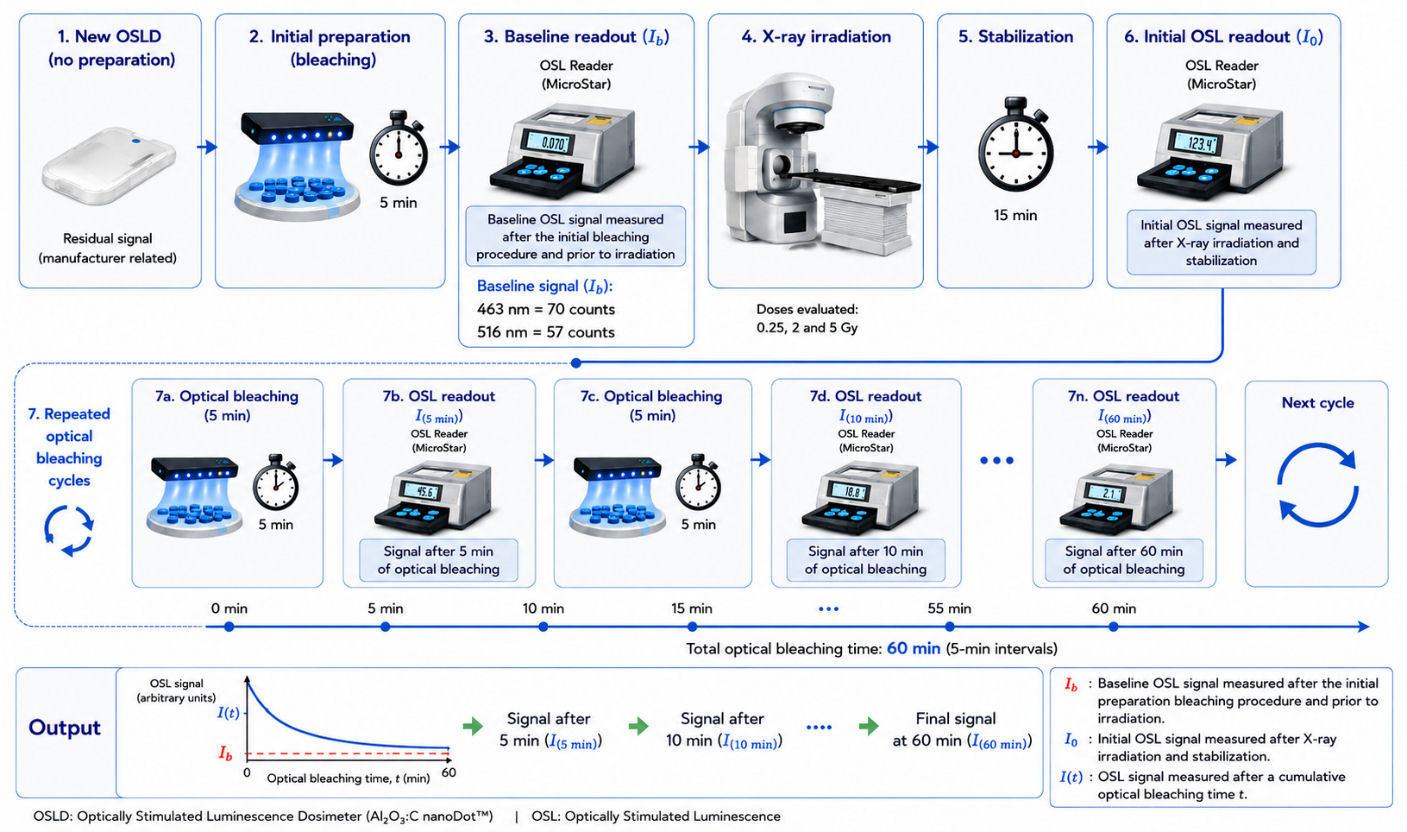
The reusability of Al2O3:C-based optically stimulated luminescence dosimeters (OSLDs) relies on efficient removal of the stored signal through optical irradiation. Wavelength-dependent optical bleaching was evaluated in nanoDotTM dosimeters using 3 W LED matrices centered at 463 and 516 nm, with irradiances of 587.7 and 457.7 mW·cm−2, respectively. Dosimeters irradiated with 6 MV photons were subjected to successive 5-min bleaching cycles with intermediate microStar readouts. The 463 nm system produced faster signal reduction and higher bleaching efficiency than the 516 nm system. A residual component persisted after prolonged irradiation, indicating incomplete depletion of optically accessible trapping states under the evaluated conditions. These results support wavelength selection as a key parameter for optimizing nanoDot reuse protocols.
Downloads
References
E.G. Yukihara and S.W.S. McKeever, Optically Stimulated Luminescence: Fundamentals and Applications (Wiley, Chichester, 2011) DOI: https://doi.org/10.1002/9780470977064
P.A. Jursinic, Characterization of optically stimulated luminescent dosimeters (OSLDs) for clinical dosimetric measurements, Med. Phys. 34 (2007) 4594 DOI: https://doi.org/10.1118/1.2804555
M.S. Akselrod, V.S. Kortov, D.J. Kravetsky and V.I. Gotlib, Highly sensitive thermoluminescent anion-defective αAl2O3:C single crystal detectors, Radiat. Prot. Dosim. 32 (1990) 15 DOI: https://doi.org/10.1093/oxfordjournals.rpd.a080771
S.W.S. McKeever, Thermoluminescence of Solids (Cambridge University Press, Cambridge, 1985) DOI: https://doi.org/10.1017/CBO9780511564994
E.G. Yukihara and S.W.S. McKeever, Optically stimulated luminescence (OSL) dosimetry in medicine, Phys. Med. Biol. 53 (2008) R351 DOI: https://doi.org/10.1088/0031-9155/53/20/R01
N.K. Umisedo, E.G. Yukihara and S.W.S. McKeever, Comparison between blue and green stimulated luminescence of Al2O3:C, Radiat. Meas. 45 (2010) 181 DOI: https://doi.org/10.1016/j.radmeas.2010.02.001
E. Bulur and W. Wahl, Infrared stimulated luminescence from Al2O3:C, Radiat. Meas. 29 (1998) 639 DOI: https://doi.org/10.1016/S1350-4487(98)00076-6
A.A. Omotayo, J.E. Cygler and G.O. Sawakuchi, The effect of different bleaching wavelengths on the sensitivity of Al2O3:C optically stimulated luminescence detectors exposed to 6 MV photon beams, Med. Phys. 39 (2012) 5457 DOI: https://doi.org/10.1118/1.4742865
P.A. Jursinic, Changes in optically stimulated luminescent dosimeter dosimetric characteristics with accumulated dose, Med. Phys. 37 (2010) 132 DOI: https://doi.org/10.1118/1.3267489
A.J.J. Bos, Theory of thermoluminescence, Radiat. Meas. 33 (2001) 737 DOI: https://doi.org/10.1016/S1350-4487(01)00094-4
V. Pagonis, G. Kitis and C. Furetta, Numerical and Practical Exercises in Thermoluminescence (Springer, New York, 2006)
M. Jain, K.J. Thomsen, L. Bøtter-Jensen and A.S. Murray, Thermal transfer and apparent dose distributions in OSL dating of quartz, Radiat. Meas. 38 (2004) 101 DOI: https://doi.org/10.1016/j.radmeas.2003.07.002
A.A. Mowlavi et al., AAPM Task Group 191: Clinical use of luminescent dosimeters, Med. Phys. 47 (2020) e19 DOI: https://doi.org/10.1002/mp.13839
International Atomic Energy Agency, Absorbed Dose Determination in External Beam Radiotherapy: An International Code of Practice for Dosimetry Based on Standards of Absorbed Dose to Water (TRS-398) (IAEA, Vienna, 2000)
Downloads
Published
How to Cite
Issue
Section
License
Copyright (c) 2026 Miguel Ángel Camacho López, Isabel Morales Peña, Amanda García Garduño, Rosalía Contreras Bulnes , Adrián Sánchez Aguilar

This work is licensed under a Creative Commons Attribution-NonCommercial-NoDerivatives 4.0 International License.
Authors retain copyright and grant the Revista Mexicana de Física right of first publication with the work simultaneously licensed under a CC BY-NC-ND 4.0 that allows others to share the work with an acknowledgement of the work's authorship and initial publication in this journal.