
Granular structure and local de Broglie wavelength in fuzzy dark matter halos
DOI:
https://doi.org/10.31349/RevMexFis.72.060703Keywords:
Self-gravitating systems, dark matter, Bose condensatesAbstract
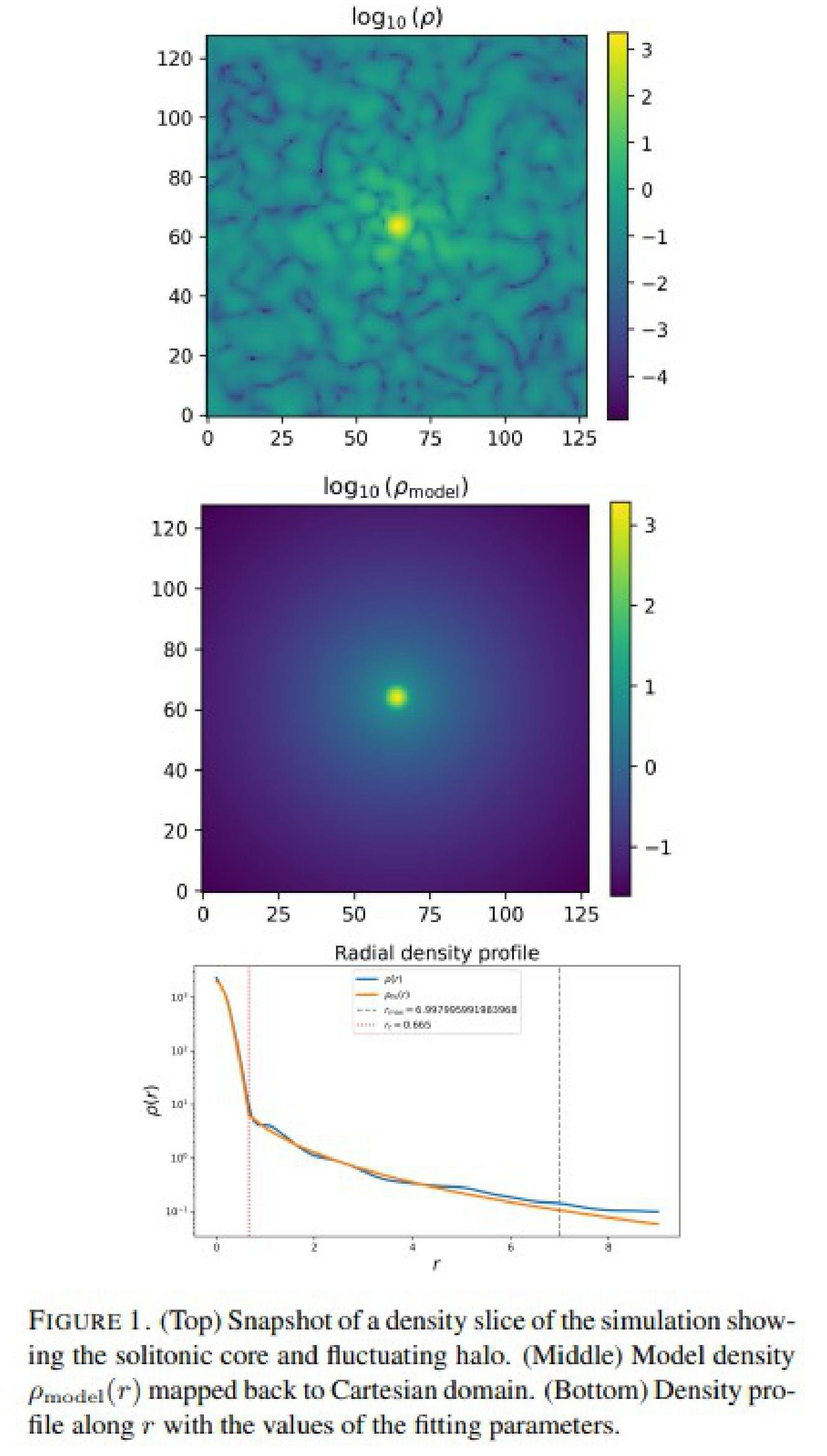
We study the granular structure that emerges in a Fuzzy Dark Matter (FDM) halo formed through kinetic relaxation. After the system reaches a virialized core-halo structure, we separate the density field into a smooth spherical component and a residual density that contains the interference pattern characteristic of FDM halos. The power spectrum of this residual field shows a well defined dominant scale, different from the characteristic scale of the total density and of the smooth core-halo model. We compare this granular scale with a local de Broglie wave-lenght calculated from the velocity field obtained from the density current of the system. We find that both scales remain of the same order of magnitude, with the granular scale systematically smaller than the de Broglie wavelength. The radial behavior of the de Broglie wavelength also reveals a non-uniform internal structure, it decreases from the core and reaches its minimum near the transition between the solitonic core and the outer halo. These results provide a quantitative connection between density fluctuations, the local velocity field, and the core-halo morphology of FDM halos.
Downloads
References
T. Matos and L. A. Ureña-López, A Further analysis of a cosmological model of quintessence and scalar dark matter, Phys. Rev. D 63 (2001) 063506 DOI: https://doi.org/10.1103/PhysRevD.63.063506
W. Hu, R. Barkana, and A. Gruzinov, Cold and fuzzy dark matter, Phys. Rev. Lett. 85 (2000) 1158 DOI: https://doi.org/10.1103/PhysRevLett.85.1158
P.-H. Chavanis, Self-gravitating Bose-Einstein Condensates, pp. 151-194 (Springer International Publishing, Cham, 2015) DOI: https://doi.org/10.1007/978-3-319-10852-0_6
L. Hui et al., Ultralight scalars as cosmological dark matter, Phys. Rev. D 95 (2017) 043541 DOI: https://doi.org/10.1103/PhysRevD.95.043541
E. G. M. Ferreira, Ultra-Light Dark Matter, arXiv e-prints (2020) arXiv:2005.03254
J. C. Niemeyer, Small-scale structure of fuzzy and axion-like dark matter, Progress in Particle and Nuclear Physics 113 (2020) 103787 DOI: https://doi.org/10.1016/j.ppnp.2020.103787
L. Hui, Wave Dark Matter, Annual Review of As- tronomy and Astrophysics 59 (2021) 247 DOI: https://doi.org/10.1146/annurev-astro-120920-010024
H.-Y. Schive, T. Chiueh, and T. Broadhurst, Cosmic Structure as the Quantum Interference of a Coherent Dark Wave, Nature Phys. 10 (2014) 496 DOI: https://doi.org/10.1038/nphys2996
P. Mocz, et al., Galaxy formation with BECDM I. Turbulence and relaxation of idealized haloes, Mon. Not. Roy. Astron. Soc. 471 (2017) 4559 DOI: https://doi.org/10.1093/mnras/stx1887
J. Veltmaat, J. C. Niemeyer, and B. Schwabe, Formation and structure of ultralight bosonic dark matter halos, Physical Review D 98 (2018 DOI: https://doi.org/10.1103/PhysRevD.98.043509
S. May and V. Springel, Structure formation in large-volume cosmological simulations of fuzzy dark matter: impact of the non-linear dynamics, Monthly Notices of the Royal Astronomical Society 506 (2021) 2603 DOI: https://doi.org/10.1093/mnras/stab1764
B. Schwabe and J. C. Niemeyer, Deep Zoom-In Simulation of a Fuzzy Dark Matter Galactic Halo, Phys. Rev. Lett. 128 (2022) 181301 DOI: https://doi.org/10.1103/PhysRevLett.128.181301
I. Álvarez-Rios, F. S. Guzmán, and P. R. Shapiro, Effect of boundary conditions on structure formation in fuzzy dark matter, Phys. Rev. D 107 (2023) 123524 DOI: https://doi.org/10.1103/PhysRevD.107.123524
I. Álvarez-Rios and F. S. Guzmán, Unveiling Orbital Chaos: The Wild Heart of Fuzzy Dark Matter Structures (2025 DOI: https://doi.org/10.1088/1361-6382/adc9f0
Y. Zhao, A. Benson, and X. Du, A semi-analytic model for effects of fuzzy dark matter granule perturbations on orbital motion, Monthly Notices of the Royal Astronomical Society 542 (2025) 508 DOI: https://doi.org/10.1093/mnras/staf1281
D. J. Marsh and J. C. Niemeyer, Strong Constraints on Fuzzy Dark Matter from Ultrafaint Dwarf Galaxy Eridanus II, Physical Review Letters 123 (2019 DOI: https://doi.org/10.1103/PhysRevLett.123.051103
F. S. Guzmán and L. A. Ureña López, Evolution of the Schrödinger-Newton system for a self-gravitating scalar field, Phys. Rev. D 69 (2004) 124033 DOI: https://doi.org/10.1103/PhysRevD.69.124033
H.-Y. Schive et al., Understanding the Core-Halo Relation of Quantum Wave Dark Matter from 3D Simulations, Phys. Rev. Lett. 113 (2014) 261302 DOI: https://doi.org/10.1103/PhysRevLett.113.261302
B. Schwabe, J. C. Niemeyer, and J. F. Engels, Simulations of solitonic core mergers in ultralight axion dark matter cosmologies, Phys. Rev. D 94 (2016) 043513 DOI: https://doi.org/10.1103/PhysRevD.94.043513
P. Mocz et al., First Star-Forming Structures in Fuzzy Cosmic Filaments, Phys. Rev. Lett. 123 (2019) DOI: https://doi.org/10.1103/PhysRevLett.123.141301
I. Álvarez-Rios et al., Galactic rotation curves of low surface brightness galaxies using core-halo fuzzy dark matter configurations, Phys. Rev. D 110 (2024) 063502
D. G. Levkov, A. G. Panin, and I. I. Tkachev, Gravitational Bose-Einstein Condensation in the Kinetic Regime, Phys. Rev. Lett. 121 (2018) 151301 DOI: https://doi.org/10.1103/PhysRevLett.121.151301
B. Eggemeier and J. C. Niemeyer, Formation and mass growth of axion stars in axion miniclusters, Phys. Rev. D 100 (2019) 063528 DOI: https://doi.org/10.1103/PhysRevD.100.063528
J. Chen et al., New insights into the formation and growth of boson stars in dark matter halos, Phys. Rev. D 104 (2021) 083022 DOI: https://doi.org/10.1103/PhysRevD.104.083022
J. Chen et al., Gravitational Bose-Einstein condensation of vector or hidden photon dark matter, Phys. Rev. D 108 (2023) 083021 DOI: https://doi.org/10.1103/PhysRevD.108.083021
K. J. Purohit et al., Formation of a Bose star in a rotating cloud, Astrophysics and Space Science 368 (2023) DOI: https://doi.org/10.1007/s10509-023-04253-8
J. Chen and H.-Y. Zhang, Novel structures and collapse of solitons in nonminimally gravitating dark matter halos, Journal of Cosmology and Astroparticle Physics 2024 (2024) 005 DOI: https://doi.org/10.1088/1475-7516/2024/10/005
I. Álvarez-Rios, F. S. Guzmán, and J. Niemeyer, Fermion- Boson Stars as Attractors in Fuzzy Dark Matter and Ideal Gas Dynamics, Phys. Rev. Lett. 135 (2025) 161003 DOI: https://doi.org/10.1103/4tkh-7hjs
C. Palomares-Chávez, I. Álvarez-Rios, and F. S. Guzmán, Black Holes as Condensation Points of Fuzzy Dark Matter Cores (2024), https://arxiv.org/abs/2412.15465 DOI: https://doi.org/10.1103/fwf5-n21g
I. Álvarez-Rios and F. S. Guzmán, Exploration of simple scenarios involving fuzzy dark matter cores and gas at local scales, Monthly Notices of the Royal Astronomical Society 518 (2022) 3838 DOI: https://doi.org/10.1093/mnras/stac3395
I. Álvarez-Rios, et al., Galactic rotation curves of low surface brightness galaxies using core-halo fuzzy dark matter configurations, Phys. Rev. D 110 (2024) 063502 DOI: https://doi.org/10.1103/PhysRevD.110.063502
I. Álvarez-Rıos and F. S. Guzmán, Construction and Evolution of Equilibrium Configurations of the Schrödinger-Poisson System in the Madelung Frame, Universe 8 (2022) 432 DOI: https://doi.org/10.3390/universe8080432
Downloads
Published
How to Cite
Issue
Section
License
Copyright (c) 2026 Flavio Rosales-Infante, Alejandro Quiñonez-Guerrero, Iván Álvarez-Rios, Francisco S. Guzmán

This work is licensed under a Creative Commons Attribution-NonCommercial-NoDerivatives 4.0 International License.
Authors retain copyright and grant the Revista Mexicana de Física right of first publication with the work simultaneously licensed under a CC BY-NC-ND 4.0 that allows others to share the work with an acknowledgement of the work's authorship and initial publication in this journal.