
Influence of active layer thickness on the performance of P3HT: PC$_{61}$BM organic photovoltaic devices analyzed via J–V characteristics
DOI:
https://doi.org/10.31349/RevMexFis.72.051003Keywords:
Organic photovoltaic cells, Active layer thickness, series resistance, shunt resistance, cell design parametersAbstract
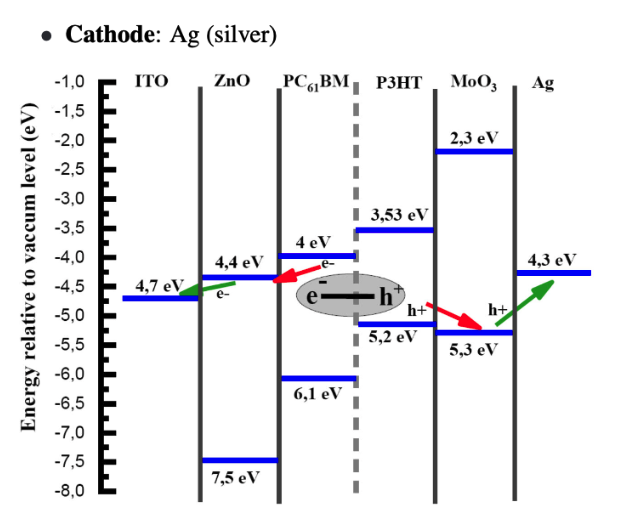
Optimizing the thickness of the active layer is essential to improve the performance of organic solar cells. In this study, we examined how the thickness of the active layer, made of a P3HT:PC61BM blend, influences the key electrical parameters of inverted organic solar cells. Four prepared photovoltaic cells were prepared using a typical device structure of ITO /ZnO /P3HT:PC61BM /MoO3 /Ag . The active layer of P3HT : PC61BM was deposited by spin coating with different thicknesses of 80, 150, 200, and 300 nm. We used the different J-V characteristics to extract parameters such as the open-circuit voltage, short-circuit current density, series resistance, and shunt resistance. Based on these measurements, the results indicate that Voc remains nearly stable between 80 nm and 200 nm, before dropping sharply at 300 nm due to recombination losses. Furthermore, Jsc increases with thickness and reaches its maximum at 300 nm, thanks to improved light absorption. The fill factor peaks (~50%) at a thickness of 150 nm, then decreases, reflecting an imbalance between charge collection and internal losses. To provide a deep understanding of this behavior, we also analyzed the resistive parameters. The series resistance Rs increases from 27.11 Ω·m² to 27.52 Ω·m² when the thickness increases from 80 to 150 nm due by the increased defect density in the layer structure with additional layer stacking, then rises to 28.87 –34.55 Ω·m² for 200–300 nm respectively because of the longer charge transport path and increased recombination. Finally, the shunt resistance Rsh increases up to 150 nm suggests improved film uniformity and better surface coverage, thus minimizing shunt defects, before decreasing at 200 and 300 nm. This suggests that increasing the material volume statistically leads to a higher density of volumetric defects.
Downloads
References
T. Yang, et al., Inverted polymer solar cells with a solutionprocessed zinc oxide thin film as an electron collection layer, Science China Chemistry 55 (2012) 755, https://doi.org/10.1007/s11426-012-4512-2 DOI: https://doi.org/10.1007/s11426-012-4512-2
L. Dou, et al., Tandem polymer solar cells featuring a spectrally matched low-bandgap polymer, Nature Photonics 6 (2012) 180, https://doi.org/10.1038/nphoton.2011.356 DOI: https://doi.org/10.1038/nphoton.2011.356
S. Saha and N. Manik, Enhancement of efficiency of Phenosafranin based organic photovoltaic devices using nano particles, Indian Journal of Physics 86 (2012) 605, https://doi.org/10.1007/s12648-012-0090-6 DOI: https://doi.org/10.1007/s12648-012-0090-6
F. Rehman, et al., Developing small molecule-based donor materials for organic solar cells: a DFT/TD-DFT insight, Indian Journal of Physics 99 (2025) 3915, https://doi.org/10.1007/s12648-025-03575-3 DOI: https://doi.org/10.1007/s12648-025-03575-3
Y. Gündo˘gdu, Third-order nonlinear optical properties of fullerene C60 in organic solvents using femtosecond laser zscan,
Indian Journal of Physics 97 (2023) 915, https://doi.org/10.1007/s12648-023-02612-3 DOI: https://doi.org/10.1007/s12648-023-02612-3
B. Ait Ali et al., Charge Transport and Photovoltaic Properties of Conjugated Polymer PTB7:PC71BM Based Solar Cells,
Transactions on Electrical and Electronic Materials 21 (2020) 436, https://doi.org/10.1007/s42341-020-00198-9 DOI: https://doi.org/10.1007/s42341-020-00198-9
A. Jouane et al., Morphological and micro-structural interface characterization in multilayer inverted polymer-fullerene bulk
heterojunction solar cells, Solar Energy Materials and Solar Cells 180 (2018) 258, https://doi.org/10.1016/j.solmat.2017.06.044 DOI: https://doi.org/10.1016/j.solmat.2017.06.044
B. Ait Ali et al., Temperature-dependent barrier height inhomogeneities in PTB7:PC71BM-based organic solar cells, Chinese Physics B 29 (2020) 098801, https://doi.org/10.1088/1674-1056/aba5fc DOI: https://doi.org/10.1088/1674-1056/aba5fc
J. Halls, et al., Efficient photodiodes from interpenetrating polymer networks, Nature 376 (1995) 498, https://doi.org/10.1038/376498a0 DOI: https://doi.org/10.1038/376498a0
G. Yu, et al., Polymer Photovoltaic Cells: Enhanced Efficiencies via a Network of Internal Donor-Acceptor Heterojunctions,Science 270 (1995) 1789, https://doi.org/10.1126/science.270.5243.1789 DOI: https://doi.org/10.1126/science.270.5243.1789
P. Das et al., Study on the series resistance of crystal violet dyebased organic photovoltaic device in presence of single walled
carbon nanotubes, Indian Journal of Physics 96 (2022) 1423, https://doi.org/10.1007/s12648-021-02051-y DOI: https://doi.org/10.1007/s12648-021-02051-y
M. Sharma et al., Organic photodiode based on PTB7-Th:PCBM as photoactive layer, Indian Journal of Physics
(2025), https://doi.org/10.1007/s12648-025-03780-0 DOI: https://doi.org/10.1007/s12648-025-03780-0
D. Gogoi et al., Influence of altered parasitic aspects on the device structure for efficient organic solar cells, Pramana - Journal of Physics 97 (2023) 188, https://doi.org/10.1007/s12043-023-02660-8
D. Gogoi et al., Influence of altered parasitic aspects on the device structure for efficient organic solar cells, Pramana - Journal of Physics 97 (2023) 188, https://doi.org/10.1007/s12043-023-02660-8 DOI: https://doi.org/10.1007/s12043-023-02660-8
A. Kyaw, et al., An inverted organic solar cell employing a solgel derived ZnO electron selective layer and thermal evaporated
MoO3 hole selective layer, Applied Physics Letters 93 (2008) 221107, https://doi.org/10.1063/1.3039076 DOI: https://doi.org/10.1063/1.3039076
D. Gogoi et al., A numerical investigation for performance enhancement of organic solar cell using Al-doped zinc oxide anode,
Indian Journal of Physics 98 (2024) 2705, https://doi.org/10.1007/s12648-023-03042-x DOI: https://doi.org/10.1007/s12648-023-03042-x
Y. Min Nam et al., Optimization of thickness and morphology of active layer for high performance of bulk-heterojunction organic
solar cells, Solar Energy Materials and Solar Cells 94(2010) 1118, https://doi.org/10.1016/j.solmat.2010.02.041 DOI: https://doi.org/10.1016/j.solmat.2010.02.041
L. Ma et al., A ternary organic solar cell with 300 nm thick active layer shows over 14 Science China Chemistry 63 (2020) 21, https://doi.org/10.1007/s11426-019-9556-7 DOI: https://doi.org/10.1007/s11426-019-9556-7
K. Liu et al., Wrinkled substrate and Indium Tin Oxidefree transparent electrode making organic solar cells thinner
in active layer, Journal of Power Sources 331 (2016) 43, https://doi.org/10.1016/j.jpowsour.2016.09.038 DOI: https://doi.org/10.1016/j.jpowsour.2016.09.038
G. Zhang et al., Active emitting layer thickness dependence and interfaces engineering studies on the performance of DOPPP
white organic light emitting diodes, Optics Communications 459 (2020) 124921, https://doi.org/10.1016/j.optcom.2019.124921 DOI: https://doi.org/10.1016/j.optcom.2019.124921
O. Dhibi et al., Active layer thickness effect on the recombination process, Superlattices and Microstructures 60 (2013) 548,
https://doi.org/10.1016/j.spmi.2013.05.032 DOI: https://doi.org/10.1016/j.spmi.2013.05.032
G. Namkoong et al., Active layer thickness effect on the recombination process of organic solar cells, Organic Electronics 14
(2013) 74, https://doi.org/10.1016/j.orgel.2012.10.025 DOI: https://doi.org/10.1016/j.orgel.2012.10.025
Q. Zhang et al., Inverted Organic Solar Cells with Low-Temperature Al-Doped ZnO Electron Transport Layer, Polymers
(2018) 127, https://doi.org/10.3390/polym10020127 DOI: https://doi.org/10.3390/polym10020127
D. Salem et al., Ag nanoparticle-based efficiency enhancement in an inverted organic solar cell, European Physical Journal
Applied Physics 90 (2020) 30201, https://doi.org/10.1051/epjap/2020200112 DOI: https://doi.org/10.1051/epjap/2020200112
S. Hwang et al., Indoor photovoltaic energy harvesting toward IoT applications, Polymer Journal 55 (2023) 297, https://doi.org/10.1038/s41428-022-00727-8 DOI: https://doi.org/10.1038/s41428-022-00727-8
I. Houiji et al., Modeling and optimization of organic tandem photovoltaic solar cells, European Physical Journal Applied
Physics 93 (2021) 20202, https://doi.org/10.1051/epjap/2021200354 DOI: https://doi.org/10.1051/epjap/2021200354
P. Berger et al., Polymer solar cells: P3HT:PCBM and beyond, Journal of Renewable and Sustainable Energy 10 (2018)
, https://doi.org/10.1063/1.5012992 DOI: https://doi.org/10.1063/1.5012992
Y. Zang et al., Effect of Active Layer Thickness on the Performance of Polymer Solar Cells Based on a Highly Efficient
Donor Material of PTB7-Th, Journal of Physical Chemistry C 122 (2018) 16532, https://doi.org/10.1021/acs.jpcc.8b03132 DOI: https://doi.org/10.1021/acs.jpcc.8b03132
H. Yao et al., Design and photovoltaic characterization of a small molecular acceptor, Angewandte Chemie International
Edition 56 (2017) 3045, https://doi.org/10.1002/anie.201610944 DOI: https://doi.org/10.1002/anie.201610944
M. Kuik et al., Determination of the trap-assisted recombination strength, Applied Physics Letters 98 (2011) 093301,
https://doi.org/10.1063/1.3559911 DOI: https://doi.org/10.1063/1.3559911
N. Sharma et al., Influence of active layer thickness on photovoltaic performance of PTB7:PC70BM, Superlattices and
Microstructures 135 (2019) 106278, https://doi.org/10.1016/j.spmi.2019.106278 DOI: https://doi.org/10.1016/j.spmi.2019.106278
J. Mescher et al., Illumination angle and layer thickness influence on the photo current generation in organic solar cells: A
combined simulative and experimental study, AIP Advances 5(2015) 077188, https://doi.org/10.1063/1.4928074 DOI: https://doi.org/10.1063/1.4928074
Y. Zang et al., Improved performance of polymer solar cells using blend film, Applied Surface Science 376 (2016) 138,
https://doi.org/10.1016/j.apsusc.2016.03.080 DOI: https://doi.org/10.1016/j.apsusc.2016.03.080
J. Zou et al., High-Performance Inverted Polymer Solar Cells,Advanced Functional Materials 22 (2012) 2804, https://doi.org/10.1002/adfm.201102937 DOI: https://doi.org/10.1002/adfm.201102937
T. Kobori and T. Fukuda, Effect of optical intensity distribution on device performances, Organic Electronics 51 (2017)76, https://doi.org/10.1016/j.orgel.2017.09.006 DOI: https://doi.org/10.1016/j.orgel.2017.09.006
A. El Karkri et al., Characterization and simulation study of organic solar cells based on donor–acceptor (D–p–A) molecular
materials, RSC Advances 10 (2020) 18816, https://doi.org/10.1039/D0RA01815E DOI: https://doi.org/10.1039/D0RA01815E
D. Zhang et al., Recent progress in thick-film organic photovoltaic devices: Materials, devices, and processing, SusMat 1
(2021) 4, https://doi.org/10.1002/sus2.10 DOI: https://doi.org/10.1002/sus2.10
Downloads
Published
How to Cite
Issue
Section
License
Copyright (c) 2026 Brahim Ait Ali, Reda Moubah

This work is licensed under a Creative Commons Attribution-NonCommercial-NoDerivatives 4.0 International License.
Authors retain copyright and grant the Revista Mexicana de Física right of first publication with the work simultaneously licensed under a CC BY-NC-ND 4.0 that allows others to share the work with an acknowledgement of the work's authorship and initial publication in this journal.