Plasma-Activated Fenton Chemistry for Acid Blue 9 dye removal: Kinetics, physicochemical dynamics, and G₅₀ optimization
DOI:
https://doi.org/10.31349/RevMexFis.72.061501Keywords:
Non-thermal plasma, AB9, triarylmethane dyeAbstract
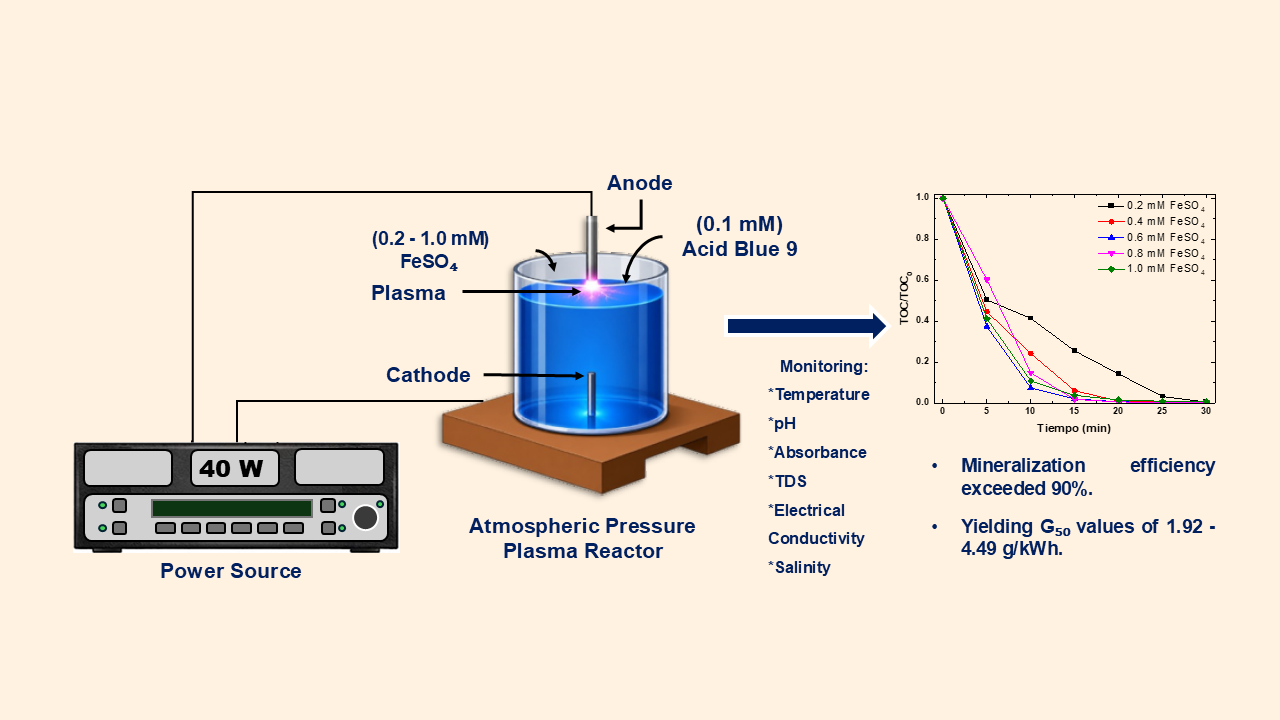
Industrial effluents containing synthetic dyes represent one of the most persistent sources of surface water contamination, largely because conventional treatment processes fail to achieve their complete removal. In this work, we evaluated the degradation efficiency of a NonThermal Atmospheric-Pressure Plasma (NTAPP) system toward Acid Blue 9 (AB9) dye, using FeSO4 as a catalytic additive at concentrations ranging from 0.2 to 1.0 mM. Degradation was monitored by UV-Vis absorbance at 630 nm, and solution physicochemical parameters pH, electrical conductivity, salinity, total dissolved solids (TDS), and bulk solution temperature were recorded throughout treatment. After 30 minutes of plasma exposure, near complete decolorization was achieved, with optimal catalytic performance observed at 0.6 mM FeSO4. The enhanced degradation at this concentration is consistent with a Fenton-type mechanism, in which Fe2+ ions react with plasma-generated H2O2 to produce additional ·OH radicals. TOC analysis confirmed a dye mineralization efficiency exceeding 90%. These results demonstrate the potential of catalytically intensified NTAPP as an effective strategy for the treatment of dye contaminated water.
Los efluentes industriales que contienen colorantes sintéticos representan una de las fuentes más persistentes de contaminación de aguas superficiales, principalmente porque los procesos de tratamiento convencionales no logran su eliminación completa. En este trabajo, evaluamos la eficiencia de degradación de un sistema de plasma a presión atmosférica no térmico (NTAPP) para el colorante Azul Ácido 9 (AB9), utilizando FeSO₄ como aditivo catalítico en concentraciones que van de 0,2 a 1,0 mM. La degradación se monitorizó mediante absorbancia UV-Vis a 630 nm, y se registraron los parámetros fisicoquímicos de la solución: pH, conductividad eléctrica, salinidad, sólidos disueltos totales (TDS) y temperatura de la solución a lo largo del tratamiento. Después de 30 minutos de exposición al plasma, se logró una decoloración casi completa, observándose un rendimiento catalítico óptimo a 0,6 mM de FeSO₄ . La degradación mejorada a esta concentración es consistente con un mecanismo tipo Fenton, en el que los iones Fe²⁺ reaccionan con el H₂O₂ generado por el plasma para producir radicales OH adicionales. El análisis de COT confirmó una eficiencia de mineralización del colorante superior al 90 %. Estos resultados demuestran el potencial del NTAPP intensificado catalíticamente como una estrategia eficaz para el tratamiento de aguas contaminadas con colorantes.
Downloads
References
M. Berradi, R. Hsissou, M. Khudhair, M. Assouag, O. Cherkaoui, A. El Bachiri and A. El Harfi, Textile finishing dyes and their impact on aquatic environs, Heliyon 5 (2019) e02711 DOI: https://doi.org/10.1016/j.heliyon.2019.e02711
G. Kavitha, M. Govindhan, and S. Premkumar, Dye pollution and its implications for human health, aquatic ecosystems, and sustainable wastewater treatment: A comprehensive review, J. Water Process Eng. 80 (2025) 109071 DOI: https://doi.org/10.1016/j.jwpe.2025.109071
E. Forgacs, T. Cserhati, and G. Oros, Removal of synthetic dyes from wastewaters: A review, Environ. Int. 30 (2004) 953 DOI: https://doi.org/10.1016/j.envint.2004.02.001
T. Robinson and G. McMullan and R. Marchant and P. Nigam, Remediation of dyes in textile effluent: A critical review on current treatment technologies with a proposed alternative, Bioresour. Technol. 77 (2001) 247 DOI: https://doi.org/10.1016/S0960-8524(00)00080-8
S. Samsami and M. Mohamadizaniani and M. H. Sarrafzadeh and E. R. Rene and M. Firoozbahr, Recent advances in the treatment of dye-containing wastewater from textile industries: Overview and perspectives, Process Saf. Environ. Prot. 143 (2020) 138 DOI: https://doi.org/10.1016/j.psep.2020.05.034
H. Zollinger, Color chemistry: Syntheses, properties, and applications of organic dyes and pigments, 3rd ed. (Wiley-VCH, 2003), pp. 1-367
M. A. Shannon and P. W. Bohn and M. Elimelech and J. G. Georgiadis and B. J. Mariñas and A. M. Mayes, Science and technology for water purification in the coming decades, Nature 452 (2008) 301 DOI: https://doi.org/10.1038/nature06599
V. Katheresan, J. Kansedo, and S. Y. Lau, Efficiency of various recent wastewater dye removal methods: A review, J. Environ. Chem. Eng. 6 (2018) 4676 DOI: https://doi.org/10.1016/j.jece.2018.06.060
J. A. Garrido-Cardenas and B. Esteban-García and A. Agüera and J. A. Sánchez-Pérez and F. Manzano-Agugliaro, Wastewater treatment by advanced oxidation processes and their worldwide research trends, Int. J. Environ. Res. Public Health 17 (2020) 170 DOI: https://doi.org/10.3390/ijerph17010170
Y. Deng and R. Zhao, Advanced oxidation processes (AOPs) in wastewater treatment, Curr. Pollut. Rep. 1 (2015) 167 DOI: https://doi.org/10.1007/s40726-015-0015-z
M. A. Oturan and J. J. Aaron, Advanced oxidation processes in water/wastewater treatment: Principles and applications. A review, Crit. Rev. Environ. Sci. Technol. 44 (2014) 2577 DOI: https://doi.org/10.1080/10643389.2013.829765
A. Barjasteh and Z. Dehghani and P. Lamichhane and N. Kaushik and E. H. Choi and N. K. Kaushik, Recent progress in applications of non-thermal plasma for water purification, Appl. Sci. 11 (2021) 3372 DOI: https://doi.org/10.3390/app11083372
P. Bruggeman and C. Leys, Non-thermal plasmas in and in contact with liquids, J. Phys. D: Appl. Phys. 42 (2009) 053001 DOI: https://doi.org/10.1088/0022-3727/42/5/053001
H. Zeghioud and P. Nguyen-Tri and L. Khezami and A. Amrane and A. A. Assadi, Review on discharge plasma for water treatment: Mechanism, reactor geometries, active species and combined processes, J. Water Process Eng. 38 (2020) 101664 DOI: https://doi.org/10.1016/j.jwpe.2020.101664
J. Sánchez, J. Beltrán, and M. T. Rodríguez, Removal of Erioglaucine (Acid Blue 9) with a new coagulant agent from Acacia mearnsii tannin extract, Coloration Technol. 128 (2012) 15 DOI: https://doi.org/10.1111/j.1478-4408.2011.00342.x
M. Flury and H. Flühler, Tracer characteristics of Brilliant Blue FCF, Soil Sci. Soc. Am. J. 59 (1995) 22 DOI: https://doi.org/10.2136/sssaj1995.03615995005900010003x
A. V. Borhade, D. R. Tope, and G. B. Dabhade, Removal of Erioglaucine dye from aqueous medium using ecofriendly synthesized ZnMnO3, e-J. Surf. Sci. Nanotechnol. 15 (2017) 74 DOI: https://doi.org/10.1380/ejssnt.2017.74
E. Brillas, I. Sirés, and M. A. Oturan, Electro-Fenton process and related electrochemical technologies based on Fenton’s reaction chemistry, Chem. Rev. 109 (2009) 6570 DOI: https://doi.org/10.1021/cr900136g
J. J. Pignatello, E. Oliveros, and A. MacKay, Advanced oxidation processes for organic contaminant destruction based on the Fenton reaction and related chemistry, Crit. Rev. Environ. Sci. Technol. 36 (2006) 1 DOI: https://doi.org/10.1080/10643380500326564
A. Fridman, Plasma chemistry (Cambridge University Press, 2008 DOI: https://doi.org/10.1017/CBO9780511546075
H. Ghodbane and A. Y. Nikiforov and O. Hamdaoui and P. Surmont and F. Lynen and G. Willems and C. Leys, Non-thermal plasma degradation of anthraquinonic dye in water: Oxidation pathways and effect of natural matrices, J. Adv. Oxid. Technol. 17 (2014) 372 DOI: https://doi.org/10.1515/jaots-2014-0223
A. Babuponnusami and K. Muthukumar, A review on Fenton and improvements to the Fenton process for wastewater treatment, J. Environ. Chem. Eng. 2 (2014) 557 DOI: https://doi.org/10.1016/j.jece.2013.10.011
M. Rahimpour and M. Rahimpour and H. Taghvaei and S. Zafarnak and M. R. Rahimpour and M. R. Rahimpour and S. Raeissi, Post-discharge DBD plasma treatment for degradation of organic dye in water: A comparison with different plasma operation methods, J. Environ. Chem. Eng. 7 (2019) 103220 DOI: https://doi.org/10.1016/j.jece.2019.103220
M. A. Malik, Water purification by plasmas: Which reactors are most energy efficient?, Plasma Chem. Plasma Process. 30 (2009) 21 DOI: https://doi.org/10.1007/s11090-009-9202-2
Y. Cao and G. Qu and T. Li and N. Jiang and T. Wang, Review on reactive species in water treatment using electrical discharge plasma: Formation, measurement, mechanisms and mass transfer, Plasma Sci. Technol. 20 (2018) 103001 DOI: https://doi.org/10.1088/2058-6272/aacff4
CalcUle MX, Precio kWh CFE 2026: Tarifas 1, 1B, 1C, DAC y Recibo
Y. Zhang and K. Shaad and D. Vollmer and C. Ma, Treatment of textile wastewater using advanced oxidation processes-A critical review, Water 13 (2021) 3515 DOI: https://doi.org/10.3390/w13243515
N. Azbar, T. Yonar, and K. Kestioglu, Comparison of various advanced oxidation processes and chemical treatment methods for COD and color removal from a polyester and acetate fiber dyeing effluent, Chemosphere 55 (2003) 35 DOI: https://doi.org/10.1016/j.chemosphere.2003.10.046
S. Mehdizadeh and S. Sadjadi and S. J. Ahmadi and M. Outokesh, Removal of heavy metals from aqueous solution using platinum nanoparticles/Zeolite-4A, J. Environ. Health Sci. Eng. 12 (2014) 7 DOI: https://doi.org/10.1186/2052-336X-12-7
E. N. Kadioglu and H. A. Eroglu and H. Ozturk and F. Akbal and A. Kuleyin, Enhanced degradation of textile wastewater by activated carbon-assisted Fenton oxidation: Economic analysis and ANN-based optimization, Biomass Conv. Bioref. 15 (2025) 17775 DOI: https://doi.org/10.1007/s13399-025-06599-1
M. N. Chong and B. Jin and C. W. Chow and C. Saint, Recent developments in photocatalytic water treatment technology: A review, Water Res. 44 (2010) 2997 DOI: https://doi.org/10.1016/j.watres.2010.02.039
K. Ikehata and M. G. El-Din, Aqueous pesticide degradation by ozonation and ozone-based advanced oxidation processes: A review (Part I), Ozone: Sci. Eng. 27 (2005) 83 DOI: https://doi.org/10.1080/01919510590925220
Downloads
Published
How to Cite
Issue
Section
License
Copyright (c) 2026 Josefina Vergara, Ernesto Gutierrez, Cesar Torres Segundo, Esteban Montiel, Benjamin Bazaldua, Aarón Gómez, Pedro Guillermo Reyes, Horacio Martinez

This work is licensed under a Creative Commons Attribution-NonCommercial-NoDerivatives 4.0 International License.
Authors retain copyright and grant the Revista Mexicana de Física right of first publication with the work simultaneously licensed under a CC BY-NC-ND 4.0 that allows others to share the work with an acknowledgement of the work's authorship and initial publication in this journal.